Request
Get your instant quote and place order
Enter the call date, start time, the patient's language and the kind of call, such as a results call or a family update. The price for the time you book shows right away.
Phone interpretation (OPI)Serbian
Medically credentialed Serbian interpreters for pre-admission calls, family updates, results and calls after discharge. Get your quote in seconds, place your order, and you're all set.

Starting at $92.91
Per hour

Court-certified
Interpreters

HIPAA-aligned
All clinical sessions

Medically credentialed
CCHI and NBCMI certified interpreters
Request
Enter the call date, start time, the patient's language and the kind of call, such as a results call or a family update. The price for the time you book shows right away.

Match
Our dispatcher assigns a medically credentialed interpreter, and you see the name and credentials before the call.
Confirmed in your dashboard and by email

Phone (OPI)
At the booked time the unit, the patient and any relatives dial in, and the interpreter stays on the line for the time you booked.
Any phone, no app or link needed
The price shows before you book. Every session is covered by an NDA; clinical sessions are handled in line with HIPAA.
Book an interpreterThe language
Chicago, NYC, Pittsburgh and Detroit have long-established Serbian-American communities, with newer arrivals from post-Yugoslav conflicts.
Calls hospitals book
Phone work at a hospital is a series of short calls around a stay. Where a card has a page of its own, it links to the phone page for that call.

A nurse calls the patient before a planned stay to confirm the arrival time, the medicines to bring and how to prepare for the procedure.
Typical calls
The care team calls relatives who are not at the hospital, so the family hears how the patient is doing in their own language.
Typical calls

A doctor or nurse calls with a result and explains what comes next, and the patient can ask questions on the same call.
Typical calls
The unit checks on the patient at home, and the interpreter interprets the questions about recovery, medicines and symptoms.
Typical calls

Patients without video join a follow-up visit by phone, and the interpreter interprets between the clinician and the patient.
Typical calls
The hospital's front office calls about appointments, referrals or a bill, and the interpreter interprets both sides of the call.
Typical calls
Calls with patients
A hospital uses the phone when the conversation is short and nobody has to see the patient or a document, such as a results call, a pre-admission check or a question after discharge. The call is booked for a set time, like any other session. The interpreter can dial in from any state, which helps when no interpreter for the language works near the hospital.
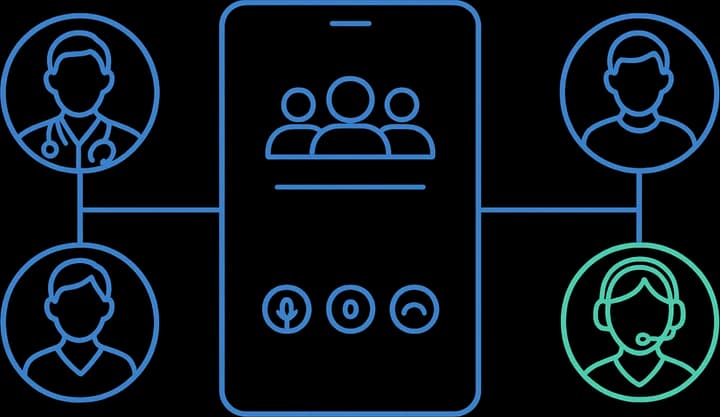
The nurse or doctor who is calling and the patient are on the line, and the patient answers and asks questions. Sometimes a relative listens in from another place. The nurse or doctor speaks to the patient through the interpreter, who interprets for each person on the line in turn. The unit decides who listens in.
On the phone nobody can see who is speaking, so the interpreter waits for the caller to finish each part before interpreting it. Every part is interpreted in full for the patient, and the patient's reply is interpreted back the same way. The interpreter gives no advice, opinion or summary, and keeps the call confidential.
On a results call
Nothing can be shown on a call, so anything the patient needs to follow, such as discharge instructions or a medicine list, should reach them before the call or after it. The dial-in number and the access code are in the project, and the unit can share them with a relative who will listen in. On a results call each part is said twice, so leave time for the patient's questions.
On-site, video or phone
Phone fits conversations that need no picture. Choose another setting when the patient has to be seen.

Book an interpreter in the room for consent talks, family meetings and discharge teaching with the patient present.
On-Site Interpretation for Hospitals
Video fits a call where the doctor needs to see the patient, or where a family member should see the care team.
Video-Remote Interpretation for HospitalsPhone fits results calls, family updates and checks after discharge, where the talk is short and nothing is shown.
How it works

Enter your details and get your instant quote
Enter the date, start time, the patient's language and the kind of call. The price for the booked time shows right away.

Place your order
Pay online to confirm. The booking opens in your dashboard with a dial-in number and an access code to share with the patient and any relatives.

Dispatcher runs and assigns an interpreter
Our dispatcher assigns a medically credentialed interpreter and sends you the name and credentials.

Join your session
When the time comes, everyone dials in. The interpreter can add a third party once everyone is on the line, and stays for the booked time.
What you receive
Every file and session is covered by an NDA and sent over an encrypted connection. Clinical matters are handled in line with HIPAA.
If you also need translations
A PDF can reach the care team before the call, so the records are in English when the call starts.
Records and vaccination records from abroad, translated so the doctor has the patient's history in English before the call.
Birth and marriage certificates a relative sends ahead, translated into English.
Affidavits and other legal papers, translated before the call.


 Not in the list? We translate 37 document types, from passports and bank statements to patents, each with its own page and the same certification.Browse all documents
FAQ
The ones we hear most often, answered by our dispatch and project-management teams.
Can't find it here?
The patient dials the number in your confirmation from any phone and enters the access code. No app or link is needed.
Yes. Share the dial-in number and the access code with them, or ask the interpreter to add them once everyone is on the line.
We can change the booking to video, depending on the interpreter's availability.
We record a call only if you ask. The interpreter works under an NDA, and clinical calls are handled in line with HIPAA.
A phone call is priced by the time you book, and the total shows before you pay. Leave a little room beyond the expected length, because unused time is not refunded.
70 languages. Spanish, Mandarin, Arabic, Russian and Haitian Creole are the easiest to schedule by phone, and rare languages need more notice.
Yes. Court-certified and medically credentialed Serbian interpreters are assigned to legal and clinical matters — Federal Court Interpreter Certification, state court rosters, CCHI / NBCMI for medical. For community, educational and corporate settings we assign professionally trained interpreters matched to the subject.
Other languages
The same page for each of these languages, with that language's varieties, its register and where it is booked most.
Related interpretation services
On-site, video and phone Serbian interpreters for courts, hospitals, USCIS interviews, schools and workplaces, in every state.
ExploreMedically credentialed Serbian interpreters for clinic calls with patients who dial in from any phone.
ExploreMedically credentialed Serbian interpreters for a dental office's calls with patients and families.
ExploreMedically credentialed Serbian interpreters for care team calls about results, medicines and follow-up.
ExploreStart a project
Tell us the date, the time and the patient's language. The interpreter's name and credentials reach you before the call starts.
Linguist network
Browse selected Serbian interpreters available through the Texliff network.
1 professional profile
Interpreter


