Medically credentialed Croatian interpreters for dental consultations, treatment plan reviews and follow-ups by video. Get your quote in seconds, place your order, add your meeting link, and you're all set.
Enter the call date, start time, platform, the patient's language and the kind of conversation, such as a consultation. The price for the hours you book shows right away.
Zoom, Microsoft Teams, Google Meet or the Texliff room
Chicago, Pittsburgh, Cleveland and New York have the oldest Croatian-American communities.
U.S. speakers
400k+
Booked most in
Chicago, Cleveland, Pittsburgh
Varieties
Croatian, Bosnian and Serbian are mutually intelligible; the standards differ in orthography (Croatian: Latin only), lexicon and some grammar. We never substitute.
Conversations held by video
Video interpreters for dentists for consultations, treatment plan reviews and follow-ups
Dental offices use video for conversations that do not need the patient in the chair. Each card is one of them.
Consultations
The dentist talks with a new patient about their concerns and what to do next, and the interpreter joins by video.
What to know about video interpreters for dental offices
When video is used
Dental offices use video for the conversations around the work, such as consultations, treatment plan reviews and follow-ups after a procedure. The patient does not have to be in the chair, so the dentist can talk from the office and the patient from home. The interpreter joins the link as a guest from anywhere in the US, which helps when no interpreter for the language works near the office.
Who takes part
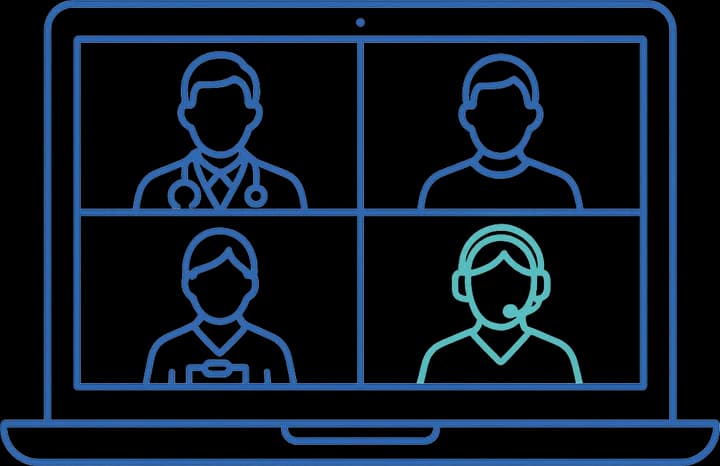
The dentist leads the call, and the patient answers and asks questions. A parent or relative may join from the same room or from another place, and office staff can join to answer questions about cost. The interpreter is on the call for everyone who speaks, and interprets each person's turn for the patient.
On the call5
DentistLeads the call
PatientAnswers and asks questions
Parent or relativeJoins from the room or another place
Office staffAnswer questions about cost
InterpreterOn the call for everyone who speaks
DentistInterpreterPatient
The interpreter's role
On the call, the interpreter interprets everything the dentist and the patient say, in both directions and in full, so the patient follows the plan as easily as an English speaker would. The dentist waits after each part, and any figure the staff give is interpreted as stated. The interpreter does not recommend a treatment or give an opinion, and keeps the call confidential.
Treatment names and tooth terms are easier to interpret with a list ahead of the call. Add the plan, the procedure names and the estimate to the booking notes in the dashboard, and the interpreter reads them before the call. In a plan review the dentist explains an option, the interpreter interprets, and the patient's questions are interpreted back, so the review takes longer than it would in English.
On-site, video or phone
Choosing between video, on-site and phone for dental visits
Video suits conversations that do not need the patient in the chair. When the work is at the chair, or a quick call will do, another setting fits better.
On-site
Book an interpreter in the office for an exam, a procedure or a consent talk before surgery.
Questions about video interpreters for dental offices
The ones we hear most often, answered by our dispatch and project-management teams.
Can't find it here?
01Can the interpreter join our office's video platform?
Yes, on Google Meet, Zoom or Microsoft Teams. If your office has no platform, ask for a Texliff room link and we add it to the project.
02Does the patient need to install anything?
The Texliff room opens in a browser with nothing to install. On Zoom, Microsoft Teams or Google Meet, the patient joins the way they usually do.
03Is the video call recorded?
Only if you ask, and connections are encrypted.
04How is a video call priced?
A video call is priced by the hour, and the total shows before you pay. A treatment plan review can run long when the patient has questions, so book some extra time, since unused time is not refunded.
05What if the family speaks two languages besides English?
A booking covers English and one other language. The second language needs its own booking, which can share the same link.
06Which languages can a dental office book by video?
70 languages. Spanish, Mandarin, Vietnamese, Korean and Russian are the easiest to schedule. Rare languages such as Burmese or Pashto need more notice, and the interpreter can join from any state.
07Are your Croatian interpreters certified?
Yes. Court-certified and medically credentialed Croatian interpreters are assigned to legal and clinical matters — Federal Court Interpreter Certification, state court rosters, CCHI / NBCMI for medical. For community, educational and corporate settings we assign professionally trained interpreters matched to the subject.
Other languages
Other languages for Dentists
The same page for each of these languages, with that language's varieties, its register and where it is booked most.
Browse selected Croatian interpreters available through the Texliff network.
1 professional profile
Jelena M.
Interpreter
Pairs
Serbian into EnglishCroatian into EnglishBosnian into EnglishEnglish into Serbian
Modes
Consecutive, Simultaneous
Settings
On-site, Video-Remote, Telephone
Jelena is a registered interpreter and translator with 15 years of professional experience, providing services between English and Serbian, Croatian, and Bosnian. She offers both consecutive and simultaneous interpretation across on-site, video remote, and telephone settings, alongside translation from Serbian (Cyrillic) into English. Jelena is registered with the Judicial Council of and has served as an official interpreter and translator for numerous federal and state courts, as well as the U.S. Environmental Protection Agency. Her specializations span legal, medical, technical, financial, marketing, IT/software, immigration, education, scientific, literary, and business domains. Jelena’s extensive experience includes interpreting medical and legal proceedings such as trials, hearings, depositions, and arbitrations, as well as serving as a conference and workshop interpreter. She holds a Bachelor of Arts in Dramatic Arts and has pursued studies in Arabic and English philology.