Tagalog Video-Remote Interpretation for Court Hearings
Court-certified Tagalog interpreters for status conferences, motion hearings and family court hearings held on the court's platform. Get your quote in seconds, place your order, add your meeting link, and you're all set.
Enter the hearing date, start time, platform and language, and name the court and the kind of hearing. The price for the hours you book shows right away.
Zoom, Microsoft Teams, Google Meet or the Texliff room
We interpret for hospital and hospice appointments (especially for Filipino elders), school meetings, and VA / military-dependent matters.
Typical Tagalog bookings
Hospital and hospice appointments for Filipino elders
School IEP meetings and parent conferences
VA claims for Filipino-American veterans
USCIS naturalization interviews
Immigration-court hearings for visa overstays and adjustment
Nurse-licensure interviews (CGFNS / NCSBN)
U.S. speakers
1.7M+
Booked most in
Los Angeles, Las Vegas, San Diego
Varieties
Filipino / Tagalog uses substantial English code-switching ("Taglish"), especially in urban and healthcare contexts. We interpret natural register and do not over-formalise.
Remote hearings
Video interpreters for court hearings, from status conferences to family court and small claims
Parties and attorneys book a video interpreter for the hearings below. The court may appoint its own interpreter for the record, so a party's booking is for the talk with their attorney, or for a hearing where the court lets a party bring one.
Status conferences
Judges hold status conferences to check on a case and set the next dates. Send the case name and the party's name, so the interpreter has them before the judge calls the case.
Motion hearings
Attorneys argue a motion, and the judge may ask the party questions. Add the motion papers to the booking notes, so the interpreter can read the terms before the hearing.
Family court hearings
Custody and support hearings involve parents who need to follow everything the judge and the other side say. The interpreter interprets it all, so nobody has to rely on a relative or a child to explain.
Small claims
Parties in small claims often speak for themselves, without an attorney. Tell us the court when you book, because it decides whether to appoint an interpreter or let a party bring one.
Video court hearings
What to know about court hearings with a video interpreter
When video is used
Many courts hold status conferences, motion hearings and some family and small claims hearings by video, and the judge or the court's rules decide which ones. Everyone joins the court's link from their own location, and your client can join from home or from your office as the court allows. When no interpreter for the language works near the courthouse, video lets us assign one from anywhere in the US.
Who takes part
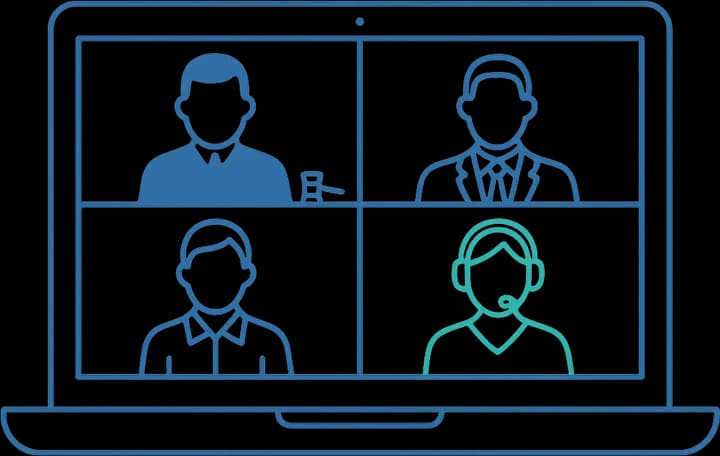
The judge runs the hearing and makes the rulings. The clerk calls the case and keeps the court's record. Attorneys speak for their clients, and the party, or a witness the judge calls, answers the judge's questions. When one of them speaks another language, an interpreter joins the call as a guest.
On the call5
JudgeRuns the hearing and makes rulings
ClerkCalls the case on the link
AttorneysSpeak for their clients
Party or witnessAnswers the judge's questions
InterpreterJoins the call as a guest
JudgeInterpreterParty
The interpreter's role
For your client, the interpreter makes the hearing as clear as it is for everyone who speaks English. Statements by the judge and the attorneys are interpreted in full, and your client's answers are interpreted into English for the record, in the first person. The interpreter stays neutral, gives no advice and keeps everything confidential.
With an interpreter
JudgeInterpretedPartyInterpreted
The court's link
Remote hearings run on the platform the court names, and the court sends the link. Add it to your booking in the dashboard as soon as you have it, together with the case name and the names of the people who will speak. A Texliff room link works for your own calls with your client, but the hearing itself runs on the court's platform.
On-site, video or phone
Choosing between video, on-site and phone for a court hearing
Video is the choice when the court holds the hearing on a link. The other settings fit the cases below.
On-site
Book an interpreter at the courthouse when your client will be in the courtroom for the hearing.
Questions about video interpreters for court hearings
The ones we hear most often, answered by our dispatch and project-management teams.
Can't find it here?
01Can the interpreter also join my call with the client before the hearing?
Yes. Book the call as its own session, on your own link or a Texliff room link. Ask for the same interpreter, and we assign them when they are available.
02Does the interpreter need to be court-certified?
Most state courts require a certified or registered court interpreter for proceedings on the record. We assign a court-certified interpreter, and you see the name and credentials before the hearing.
03Can you interpret a hearing in a court in another state?
Yes. Our video interpreters join from anywhere in the US, so the court's location does not limit who we can assign.
04What if the court moves or cancels the hearing?
Cancellation is in writing. You get a full refund more than seven days before the hearing, 75% between seven days and 48 hours before, and no refund once it is 48 hours or less before.
05How is a video court hearing priced?
It is priced by the hour for the hours you book, and you see the total before you pay. Unused time is not refunded, so book the time the court has set aside, plus some extra for a talk with your client.
06Which languages can you interpret in court hearings by video?
70 languages. Spanish, Mandarin, Vietnamese, Arabic and Haitian Creole are the easiest to schedule, and rare languages such as Burmese or Pashto need more notice.
07Are your Tagalog interpreters certified?
Yes. Court-certified and medically credentialed Tagalog interpreters are assigned to legal and clinical matters — Federal Court Interpreter Certification, state court rosters, CCHI / NBCMI for medical. For community, educational and corporate settings we assign professionally trained interpreters matched to the subject.
Other languages
Other languages for Court Hearings
The same page for each of these languages, with that language's varieties, its register and where it is booked most.
Browse selected Tagalog interpreters available through the Texliff network.
3 professional profiles
Ana B.
Interpreter
Pairs
Tagalog into English
Modes
Consecutive, Simultaneous
Settings
On-site, Video-Remote, Telephone
Ana is a professional interpreter with 15 years of experience providing consecutive and simultaneous interpretation from Tagalog into English. She delivers on-site, video remote, and telephone interpretation across a broad range of fields, including legal, medical, technical, financial, marketing, immigration, education, scientific, literary, business, and general subject matter. Ana holds a Master's degree in Intelligence Studies and a Doctor of Optometry degree. Throughout her career, Ana has served as a conference interpreter and language consultant, developing and rating oral exams to certify court interpreters. She has provided linguistic support to government agencies, contributed to legal dictionary research, and performed oral proficiency interview ratings. Her work has included interpreting for various court proceedings, transcription, editing, voice recording, and film subtitling. Ana also brings expertise in open-source research and intelligence analysis, having supported military readiness exercises and information operations.
Cecile is a Tagalog interpreter with 11 years of experience in legal, medical and immigration matters. She interprets consecutively during consultations and proceedings, while simultaneous delivery supports hearings and other fast-paced assignments. Her work takes place on-site and by secure video, with phone sessions used for medical care and urgent communications. As a certified court interpreter and trained, certified immigration court interpreter, she handles complex terminology with accuracy and clarity. Cecile also provides certified Tagalog translation for legal and medical content. Her language work includes Tagalog to English translation as well as English into Tagalog translation, supporting documents that require precise terminology and faithful meaning.
Alfonso works as an English into Tagalog interpreter, providing interpretation services in legal, medical and immigration matters. With 31 years of professional experience, he handles consecutive communication on-site and by video or phone, while simultaneous work supports proceedings that require immediate spoken-language delivery. As a legal interpreter, he has covered court proceedings and full-day trial assignments, conveying meaning, tone and context with confidentiality, impartiality and cultural sensitivity. His medical interpreter work facilitates clear communication during healthcare encounters, while his immigration experience supports interviews and related appointments. Extensive knowledge of Tagalog, Filipino cultural expressions and cross-cultural communication helps him address idioms and nuanced language accurately. Alfonso also completes Tagalog to English translation for legal and medical documents. His document translation work contributes to certified Tagalog translation projects requiring careful terminology, faithful meaning and close attention to context.