Punjabi Video-Remote Interpretation for Court Hearings
Court-certified Punjabi interpreters for status conferences, motion hearings and family court hearings held on the court's platform. Get your quote in seconds, place your order, add your meeting link, and you're all set.
Enter the hearing date, start time, platform and language, and name the court and the kind of hearing. The price for the hours you book shows right away.
Zoom, Microsoft Teams, Google Meet or the Texliff room
Sikh communities in California's Central Valley (Yuba City / Fresno), Bay Area (Fremont), NY / NJ, Vancouver-adjacent (WA), and Seattle drive most demand.
Typical Punjabi bookings
USCIS naturalization and asylum interviews
Trucking-industry regulatory hearings
Agricultural workers' comp and OSHA
Gurdwara-community events and legal matters
U.S. speakers
300k+
Booked most in
Bay Area, New York, Central California
Remote hearings
Video interpreters for court hearings, from status conferences to family court and small claims
Parties and attorneys book a video interpreter for the hearings below. The court may appoint its own interpreter for the record, so a party's booking is for the talk with their attorney, or for a hearing where the court lets a party bring one.
Status conferences
Judges hold status conferences to check on a case and set the next dates. Send the case name and the party's name, so the interpreter has them before the judge calls the case.
Motion hearings
Attorneys argue a motion, and the judge may ask the party questions. Add the motion papers to the booking notes, so the interpreter can read the terms before the hearing.
Family court hearings
Custody and support hearings involve parents who need to follow everything the judge and the other side say. The interpreter interprets it all, so nobody has to rely on a relative or a child to explain.
Small claims
Parties in small claims often speak for themselves, without an attorney. Tell us the court when you book, because it decides whether to appoint an interpreter or let a party bring one.
Video court hearings
What to know about court hearings with a video interpreter
When video is used
Many courts hold status conferences, motion hearings and some family and small claims hearings by video, and the judge or the court's rules decide which ones. Everyone joins the court's link from their own location, and your client can join from home or from your office as the court allows. When no interpreter for the language works near the courthouse, video lets us assign one from anywhere in the US.
Who takes part
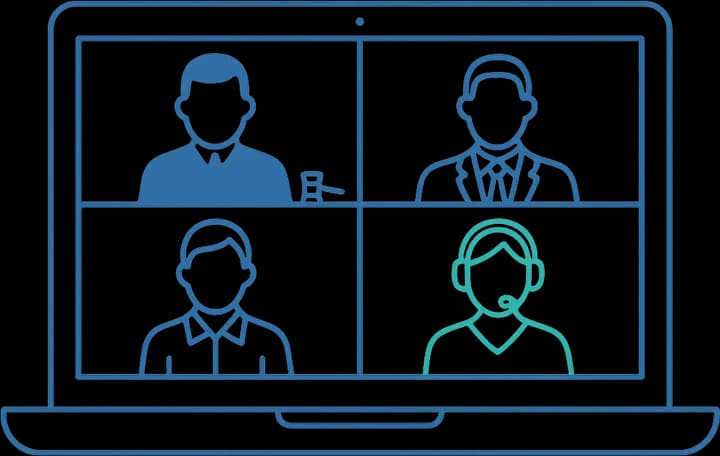
The judge runs the hearing and makes the rulings. The clerk calls the case and keeps the court's record. Attorneys speak for their clients, and the party, or a witness the judge calls, answers the judge's questions. When one of them speaks another language, an interpreter joins the call as a guest.
On the call5
JudgeRuns the hearing and makes rulings
ClerkCalls the case on the link
AttorneysSpeak for their clients
Party or witnessAnswers the judge's questions
InterpreterJoins the call as a guest
JudgeInterpreterParty
The interpreter's role
For your client, the interpreter makes the hearing as clear as it is for everyone who speaks English. Statements by the judge and the attorneys are interpreted in full, and your client's answers are interpreted into English for the record, in the first person. The interpreter stays neutral, gives no advice and keeps everything confidential.
With an interpreter
JudgeInterpretedPartyInterpreted
The court's link
Remote hearings run on the platform the court names, and the court sends the link. Add it to your booking in the dashboard as soon as you have it, together with the case name and the names of the people who will speak. A Texliff room link works for your own calls with your client, but the hearing itself runs on the court's platform.
On-site, video or phone
Choosing between video, on-site and phone for a court hearing
Video is the choice when the court holds the hearing on a link. The other settings fit the cases below.
On-site
Book an interpreter at the courthouse when your client will be in the courtroom for the hearing.
Questions about video interpreters for court hearings
The ones we hear most often, answered by our dispatch and project-management teams.
Can't find it here?
01Can the interpreter also join my call with the client before the hearing?
Yes. Book the call as its own session, on your own link or a Texliff room link. Ask for the same interpreter, and we assign them when they are available.
02Does the interpreter need to be court-certified?
Most state courts require a certified or registered court interpreter for proceedings on the record. We assign a court-certified interpreter, and you see the name and credentials before the hearing.
03Can you interpret a hearing in a court in another state?
Yes. Our video interpreters join from anywhere in the US, so the court's location does not limit who we can assign.
04What if the court moves or cancels the hearing?
Cancellation is in writing. You get a full refund more than seven days before the hearing, 75% between seven days and 48 hours before, and no refund once it is 48 hours or less before.
05How is a video court hearing priced?
It is priced by the hour for the hours you book, and you see the total before you pay. Unused time is not refunded, so book the time the court has set aside, plus some extra for a talk with your client.
06Which languages can you interpret in court hearings by video?
70 languages. Spanish, Mandarin, Vietnamese, Arabic and Haitian Creole are the easiest to schedule, and rare languages such as Burmese or Pashto need more notice.
07Are your Punjabi interpreters certified?
Yes. Court-certified and medically credentialed Punjabi interpreters are assigned to legal and clinical matters — Federal Court Interpreter Certification, state court rosters, CCHI / NBCMI for medical. For community, educational and corporate settings we assign professionally trained interpreters matched to the subject.
Other languages
Other languages for Court Hearings
The same page for each of these languages, with that language's varieties, its register and where it is booked most.
Browse selected Punjabi interpreters available through the Texliff network.
5 professional profiles
Reena S.
Interpreter
Pairs
English into UrduEnglish into HindiEnglish into PunjabiUrdu into English
Modes
Consecutive, Simultaneous
Settings
On-site, Video-Remote, Telephone
Reena is a certified court interpreter with over 11 years of experience providing consecutive and simultaneous interpretation between English and Urdu, Hindi, and Punjabi. She holds a bachelor's degree with a major in psychology and a minor in social work, along with undergraduate coursework in nursing and small group communication. A licensed certified court interpreter since 2018, Reena has extensive experience working in municipal, justice, and district court settings as well as correctional facilities and school districts. She has supported professionals in conducting psychosexual evaluations, drug and alcohol evaluations, parole and probation interviews, and pre-sentencing interviews. Reena delivers interpretation services across on-site, video remote, and telephone settings. Her specializations span legal, medical, technical, immigration, education, general, business, marketing, and financial fields.
English into PashtoEnglish into UrduEnglish into HindiEnglish into Punjabi
Modes
Consecutive
Settings
Video-Remote, Telephone
A court-registered Pashto interpreter, Shadab provides consecutive language support from English into Pashto and Urdu. He also works from English into Hindi and Punjabi, serving as an Urdu interpreter, Hindi interpreter and Punjabi interpreter for legal proceedings, medical appointments and immigration matters. Through video and phone sessions, he uses active listening, contextual comprehension and cultural sensitivity to facilitate clear conversations between participants. His three years of experience include work in courts, healthcare environments and community settings, where he helps speakers navigate complex terminology and cultural differences. Shadab has completed a 40-hour community language training program and also holds qualified status. In addition to interpretation services, he supports translation assignments involving the same languages, drawing on fluency in English, Pashto and Urdu as well as Hindi and Punjabi.
English into PunjabiEnglish into HindiEnglish into Urdu
Modes
Consecutive, Simultaneous
Settings
On-site, Video-Remote, Telephone
Preeti is a court-certified Punjabi interpreter who works from English into Punjabi, with more than three years of experience in legal proceedings and immigration matters. She also works from English as a Hindi interpreter and Urdu interpreter, preserving context and meaning while navigating linguistic and cultural barriers. Preeti provides consecutive support on-site or by video for court cases, pretrial conferences and depositions. She handles simultaneous assignments for trials and mediations, as well as phone sessions for urgent matters when scheduling permits. Beyond legal work, her interpretation services cover medical visits, counseling sessions and behavioral health settings. She follows ethical practices, protects confidentiality and brings strong intercultural competence to sensitive communications.
English into PunjabiPunjabi into EnglishEnglish into UrduUrdu into English
Modes
Consecutive
Settings
On-site, Telephone, Video-Remote
Rahul is a court-qualified interpreter working from English into Punjabi and Punjabi into English, as well as from English into Urdu and Urdu into English. As a Punjabi interpreter and Urdu interpreter with 15 years of experience, he handles consecutive assignments on-site and by phone or video. His legal work covers trials, depositions and settlement conferences, along with administrative hearings and immigration matters. Rahul also works as a medical interpreter during independent medical examinations, psychiatric evaluations and nerve conduction studies. Additional experience includes pain management programs, orthopedic recovery plans and functional capacity evaluations. He has supported school meetings and recorded statements for insurance claims. Beyond direct language work, Rahul has monitored quality, evaluated linguist performance and developed training modules. He has also mentored new hires, administered internal assessments and rated language proficiency.
Urdu into EnglishPunjabi into EnglishHindi into English
Modes
Consecutive, Simultaneous
Settings
Video-Remote, Telephone
Farhat is an Urdu interpreter with extensive experience in immigration court hearings and asylum-related interviews. As a Punjabi interpreter and Hindi interpreter, Farhat conducts interpretation services into English by video and phone for credible fear and affirmative asylum interviews. Farhat is certified to interpret in immigration courts after successfully completing immigration court training and brings three years of experience to this work. Continual learning strengthens Farhat’s knowledge of asylum procedures and legal terminology. As an Urdu translator, Farhat also completes Urdu to English translation, including document translation and legal translation.