Swahili Video-Remote Interpretation for Workers' Compensation Hearings
Court-certified Swahili interpreters for remote workers' compensation hearings, status conferences and settlement approvals. Get your quote in seconds, place your order, add your meeting link, and you're all set.
Enter the hearing date, start time, platform, the state and board, and the injured worker's language. The price for the hours you book shows right away.
Zoom, Microsoft Teams, Google Meet or the Texliff room
Dallas, Houston, Seattle, the Twin Cities, DC and Atlanta have established East-African communities (Kenyan, Tanzanian, Ugandan, Congolese).
Typical Swahili bookings
USCIS asylum and refugee interviews
Hospital and maternity appointments
School IEP meetings
Resettlement agency intake
U.S. speakers
120k+
Booked most in
Minneapolis, Boston, Dallas
Varieties
Kenyan Swahili (with heavier English loan), Tanzanian standard Swahili and Congolese Swahili diverge meaningfully. We disclose and match at booking.
Hearings we interpret
Video interpreters for workers' compensation hearings, from status conferences to settlement approvals
A workers' compensation case passes through several kinds of hearings, and the board and the judge decide which ones go remote. Our video interpreters join the three kinds below.
Status conferences
The judge reviews where the case stands and what comes next, with the attorneys and the injured worker on the call. The interpreter interprets for the worker, so the worker follows the dates and answers any question put to them.
Hearings before the judge
The injured worker may testify about the job, the injury and the treatment, with both attorneys asking questions. The interpreter stays on the call for the whole testimony, so the judge hears every answer in English.
Settlement approval hearings
When the parties have agreed on a settlement, a judge can review it at a hearing, and the injured worker may be asked about it. The interpreter interprets the judge's words and the worker's replies, so the replies are the worker's own.
Remote hearings
What to know about remote workers' compensation hearings with an interpreter
When video is used
Many workers' compensation hearings are held in person, at a hearing office of the state board. Whether a hearing goes remote is up to the board and the judge. When it does, everyone joins the same video call from their own location. Video is also a practical choice when the injured worker lives far from the hearing office, or when no interpreter for the language works nearby, because a video interpreter can join from anywhere in the US.
Who takes part
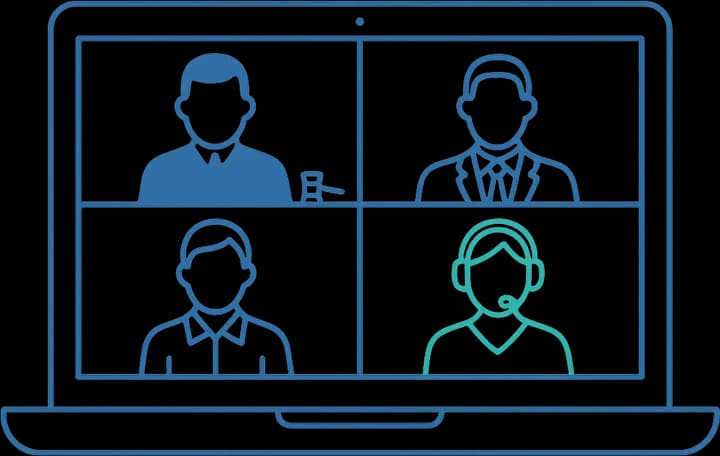
The workers' compensation judge runs the hearing and decides the issues in dispute. The injured worker testifies or answers the judge's questions. The worker's attorney and the defense attorney, who acts for the employer or the insurer, ask questions and make their arguments. A hearing reporter records what is said. When the worker speaks another language, an interpreter joins the call as well.
On the call5
JudgeRuns the hearing and decides the issues
Injured workerTestifies or answers the judge's questions
AttorneysAsk questions and make their arguments
Hearing reporterRecords what is said
InterpreterJoins when the worker speaks another language
AttorneysInterpreterWorker
The interpreter's role
The interpreter makes the hearing as clear for the injured worker as it would be in one language. Each question from the judge or an attorney is interpreted into the worker's language, and each answer into English, in full and in the first person. The interpreter is neutral and works for neither the worker's side nor the employer's side. They keep what they hear confidential and do not explain a question, give advice or comment on the testimony.
Worker's testimony
Attorney asksInterpretedWorker answersInterpreted
Link and notes
The board or the judge sets the platform for a remote hearing, so add the link to your booking in the dashboard as soon as you have it. Notes with the injured worker's job title, the injury and the names of the treating doctors help the interpreter prepare. If you do not have a link, we can create a Texliff room that opens in the browser.
On-site, video or phone
Choosing between video, on-site and phone for a workers' compensation hearing
Video suits hearings where the judge, the attorneys and the injured worker join from different places. Another setting is better in the cases below.
On-site
Book in person when the board holds the hearing at its office and the injured worker attends there.
How to book a video interpreter for a workers' compensation hearing
Enter your details and get your instant quote
In the instant quote, add the hearing date and start time, the platform, the state and board, and the injured worker's language. The price for the booked hours shows right away.
Place your order
Pay online to confirm. The booking opens in your dashboard, where you can add the hearing link and notes such as the case number and the names of the treating doctors.
Dispatcher runs and assigns an interpreter
Our dispatcher assigns a court-certified interpreter and confirms the name and credentials to you before the hearing.
Join your session
Open the hearing link at the booked time. The interpreter joins it as a guest, and the injured worker hears the hearing in their own language.
What you receive
The interpreter's name and court credentials, confirmed ahead of the hearing.
Your hearing link kept in the project, or a Texliff room link we create.
A confirmation in your dashboard and by email.
Every file and session is covered by an NDA and sent over an encrypted connection. Clinical matters are handled in line with HIPAA.
Questions about video interpreters for workers' compensation hearings
The ones we hear most often, answered by our dispatch and project-management teams.
Can't find it here?
01Which platforms can the interpreter join for a hearing?
Zoom, Microsoft Teams, Google Meet or the platform the board uses, as a guest. The Texliff room opens in the browser with nothing to install.
02Can the injured worker join from the attorney's office?
Yes. The interpreter joins from their own location in the US, so the worker can sit next to their attorney while the judge and the other side join from elsewhere.
03Can we ask for the same interpreter at a later hearing?
You can ask for it in the booking notes. A booking is for the service, not for a particular interpreter, so we take the request into account and assign them when they are available.
04How is a remote hearing priced?
By the hour, for the hours you book, and the total shows before you pay. Testimony takes longer when it is interpreted, and unused time is not refunded, so book enough hours for the whole hearing.
05How far ahead should we book?
At least 48 to 72 hours ahead, and earlier if you can.
06Which languages do you cover for workers' compensation hearings?
70 languages. Spanish, Mandarin, Arabic, Russian, Portuguese and French are the easiest to schedule. Rare languages such as Burmese or Pashto need more notice.
07Are your Swahili interpreters certified?
Yes. Court-certified and medically credentialed Swahili interpreters are assigned to legal and clinical matters — Federal Court Interpreter Certification, state court rosters, CCHI / NBCMI for medical. For community, educational and corporate settings we assign professionally trained interpreters matched to the subject.
Other languages
Other languages for Workers' Compensation Hearings
The same page for each of these languages, with that language's varieties, its register and where it is booked most.
Book a court-certified video interpreter for your workers' compensation hearing.
Tell us the date, the platform, the state and board, and the injured worker's language. We confirm the interpreter's name and credentials before the hearing.
Browse selected Swahili interpreters available through the Texliff network.
5 professional profiles
Emmanuel S.
Interpreter
Pairs
Swahili into English
Modes
Consecutive
Settings
Telephone, Video-Remote
Emmanuel handles English to Swahili translation with a strong focus on technical, medical and legal content. Across eight years of experience, he has worked on patent claims, technical specifications and regulatory filings while preserving precise terminology and document structure. His technical portfolio covers telecommunications infrastructure, network architecture and semiconductor documentation, including large-scale localization projects. Medical translation experience encompasses clinical materials, health policies and mental health content. Emmanuel also provides Somali to English translation and English to Somali translation for business documents and other professional materials. As a Swahili translator and Somali translator, he uses terminology management and quality assurance processes to maintain consistency across complex projects. Working as a Swahili interpreter, Emmanuel provides consecutive interpreting from Swahili into English during on-site legal and medical appointments. He also supports business discussions by phone and video.
Moses is a dedicated linguist with over six years of experience in translation and consecutive interpretation. Specializing in medical, immigration, education, and general fields, Moses provides remote video and telephone interpretation services. Core language pairs include Kinyarwanda to English and Swahili to English for both translation and interpretation tasks. Holding an undergraduate degree in Public Health, Moses combines subject matter expertise with strong linguistic skills to support humanitarian and community-focused initiatives. This background ensures accurate handling of complex health terminology and public health messaging. Moses is committed to delivering reliable, culturally sensitive communication solutions that bridge language barriers effectively.
Josephine is a Swahili-to-English translator and interpreter with over 17 years of professional experience. She provides consecutive and simultaneous interpretation on site, by video remote, and by telephone, along with written translation across a broad range of fields, including legal, medical, technical, financial, IT and software, marketing, immigration, education, scientific, literary, general, and business content. Josephine is especially skilled in legal and law-enforcement settings, where she facilitates clear communication among personnel, witnesses, persons of interest, suspects, and members of the public. She is recognized for careful document review, precise terminology, and the ability to preserve meaning, tone, and cultural nuance. Josephine holds a bachelor's degree in film and television.
Alumbe is a professional linguist providing translation from English into Swahili and interpretation from Swahili into English. She specializes in medical and general content and delivers simultaneous interpretation across on-site, video remote, and telephone settings. Alumbe has experience interpreting in medical, community, and social service contexts. She facilitates clear communication between Swahili-speaking clients and English-speaking providers during medical appointments, social service visits, and other community interactions. Her work covers medical histories, symptoms, treatment plans, medications, and follow-up instructions. Alumbe prepares for assignments by reviewing relevant terminology, maintains strict confidentiality, and follows professional interpreting standards while remaining neutral and respectful throughout each session.
English into FrenchEnglish into SwahiliEnglish into Afrikaans
Modes
Consecutive, Simultaneous
Settings
On-site, Video-Remote, Telephone
Bijou is a French interpreter, Swahili interpreter, and Afrikaans interpreter with five years of experience across legal and educational settings. More than 1,000 court cases have shaped Bijou’s interpretation services for criminal and civil proceedings, including hearings involving witnesses, defendants, and attorneys. Spoken assignments run from English into French, Swahili, or Afrikaans. Bijou appears on-site for court matters, joins school meetings by video, and assists with legal or educational communication by phone. Court-related work also encompasses audio and video evidence, social media content, exhibits, and case materials. For written records, Bijou completes certified French translation when documentation requires formal accuracy. English to French translation includes legal documents and court exhibits, while English to Swahili translation and English to Afrikaans translation address comparable case-related materials. Bijou also translates and transcribes recordings used as evidence in legal proceedings.