Turkish interpreters for online safety courses, onboarding, HR interviews and remote audits at your plant. Get your quote in seconds, place your order, add your meeting link, and you're all set.
Enter the date, start time, the platform, the workers' language and the kind of session, such as a course or an HR interview. The price for the hours you book shows right away.
Zoom, Microsoft Teams, Google Meet or the Texliff room
NY / NJ (Paterson, Sunnyside), Houston, Chicago, Boston and LA host Turkish-American communities.
Typical Turkish bookings
Asylum interviews and credible-fear screenings
USCIS naturalization interviews
Commercial arbitration (Turkish / TÜRKKEP)
Hospital appointments
U.S. speakers
200k+
Booked most in
New York, New Jersey, Houston
Register
Turkish uses T-V distinction (sen / siz) and honorific address (Bey / Hanım). We preserve register in formal proceedings.
Sessions plants hold by video
Video interpreters for factories for online courses, onboarding, HR interviews and remote audits
Plants hold these sessions by video when the workers' interpreter works far away, or when HR and the workers sit at different sites. Each card with a link opens the page for that session by video.
Online safety courses
The trainer runs a live course by video and pauses every few sentences, and the interpreter joins the call as a guest.
What to know about video interpreters at a factory
When video is used
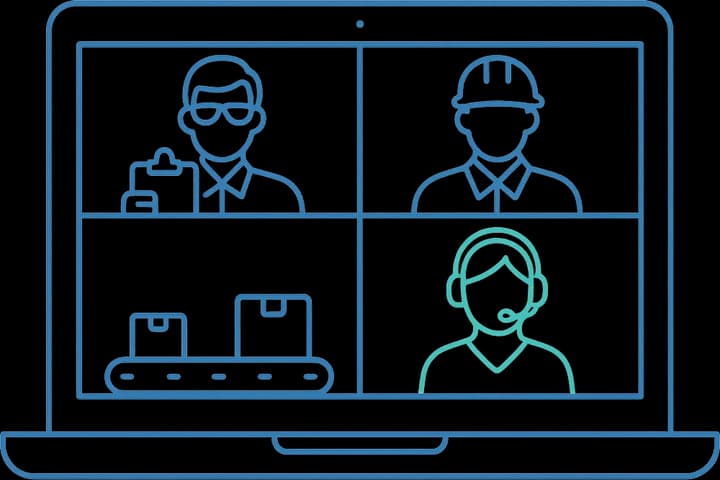
Plants book video when the interpreter for the workers' language works far from the plant, since our video interpreters join from anywhere in the US. It is also the choice when HR, the trainer or an auditor sits at a different site from the workers. The interpreter joins the call the plant already uses, and slides, forms and documents are shared on screen as in any other meeting.
Who takes part
The trainer presents a course, HR goes through forms with new hires, or a supervisor talks with a worker, depending on the session. Workers who speak another language join from the plant. The interpreter is one more guest on the call and speaks with the workers in their own language.
On the call4
TrainerPresents the course on screen
HRGoes through forms with new hires
WorkersJoin from the plant
InterpreterJoins the call as a guest
TrainerInterpreterWorkers
The interpreter's role
The interpreter's job is to give the workers what an English-speaking crew would get, with nothing cut short. Every instruction, warning and question is interpreted in full, in both directions, and the workers hear the same words the trainer or HR said. The interpreter is neutral, keeps what they hear confidential, and does not add advice or opinions of their own.
In an online course
TrainerPauseInterpretedNext part
In an HR interview
HRInterpretedWorkerInterpreted
Slides and forms ahead of time
Send the slides or forms through the booking notes before the session, so the interpreter can prepare machine names, part names and the plant's own terms. In a course, the trainer says a few sentences, pauses, and goes on once that part is interpreted. Documents in another language that the session will use can be translated into English first.
On-site, video or phone
Choosing between video, on-site and phone for a factory
Video suits sessions where the trainer, HR or an auditor is at a different site from the workers. In person or by phone is the better choice for the cases below.
On-site
Book an interpreter at the plant for hands-on safety training, where workers need to ask a question in the room.
The ones we hear most often, answered by our dispatch and project-management teams.
Can't find it here?
01Do the workers need an account or an app?
No. The Texliff room opens in the browser without installing anything, and the interpreter joins your own link as a guest.
02What if new hires speak two languages?
A booking is for English and a single other language. New hires who speak two languages need two bookings, one per language, on the same link.
03How many hours should we book for an online course?
Book the full course, plus the breaks. The trainer pauses every few sentences, which makes the course longer, and unused time is not refunded.
04Does Texliff record the session?
No, not unless the customer asks. Connections are encrypted, and every session is covered by an NDA.
05How far ahead should we book?
At least 48 to 72 hours ahead, and earlier if you can.
06Which languages can workers be served in?
70 languages. Spanish, Vietnamese, Haitian Creole, Mandarin and Arabic are the easiest to schedule, and a rare language needs more advance notice.
07Are your Turkish interpreters certified?
Yes. Court-certified and medically credentialed Turkish interpreters are assigned to legal and clinical matters — Federal Court Interpreter Certification, state court rosters, CCHI / NBCMI for medical. For community, educational and corporate settings we assign professionally trained interpreters matched to the subject.
Other languages
Other languages for Factories
The same page for each of these languages, with that language's varieties, its register and where it is booked most.
Book a video interpreter for your next online course.
Send us the date, the platform and the workers' language, and say whether it is a course, onboarding or an HR interview. The interpreter's name is confirmed before the session starts.
Browse selected Turkish interpreters available through the Texliff network.
3 professional profiles
Mehrnaz I.
Interpreter
Pairs
Dari into EnglishFarsi into EnglishAzerbaijani into EnglishTurkish into English
Modes
Simultaneous, Consecutive
Settings
Video-Remote, Telephone, On-site
Mehrnaz works as a Dari interpreter and Farsi interpreter for immigration hearings, medical encounters and legal proceedings. As an Azerbaijani interpreter and Turkish interpreter, she provides simultaneous interpreting at conferences, consecutive support on-site for hearings, and language assistance by video or phone. Her 12 years of experience also include reviewing assessment materials for linguistic accuracy, dialectal variation and cultural context. Mehrnaz is a qualified federal court interpreter, a CCHI Certified Medical Interpreter and a certified immigration court interpreter. She handles English to Farsi translation for medical and immigration documents. Her work also covers Turkish to English translation and Azerbaijani to English translation for legal materials and general records, while Dari to English translation supports document review and sight rendering in court and immigration matters.
Armen translates between Turkish and English for legal, medical and immigration matters, drawing on 25 years of language experience. His translation work supports clear communication across specialized materials while preserving meaning, tone and context. Earlier experience in accounting and commercial real estate provides additional familiarity with financial and business terminology. For spoken assignments, Armen works as a court-registered Turkish interpreter in legal proceedings and handles consecutive interpreting for medical visits. He also provides interpretation services by video and phone when participants need remote language support. His extensive background encompasses court, business and school-related assignments requiring careful communication between Turkish and English.
For 20 years, Alyson has interpreted English into Turkish in legal and medical settings. A Turkish interpreter and licensed court interpreter, she interprets hearings and other court proceedings on-site or by video. In hospitals and other healthcare settings, she conveys medical discussions accurately and clearly, including assignments conducted by phone. Her interpretation services also draw on substantial experience with business operations, bookkeeping, payroll, real estate leasing, and vendor accounts. This financial and commercial background informs her command of terminology used in business and legal matters. As a Turkish translator, Alyson completes English to Turkish translation for legal and medical documents, contracts, and business records. Her document translation reflects the same subject-matter knowledge developed through two decades of spoken-language assignments.