Turkish Video-Remote Interpretation for Mediations
Court-certified Turkish interpreters for mediations on Zoom or Microsoft Teams, moved into your client's breakout room for every private session. Get your quote in seconds, place your order, add your meeting link, and you're all set.
Enter the mediation date, start time, platform and the language of the party who needs the interpreter. The price for the hours you book shows right away.
Zoom, Microsoft Teams, Google Meet or the Texliff room
NY / NJ (Paterson, Sunnyside), Houston, Chicago, Boston and LA host Turkish-American communities.
Typical Turkish bookings
Asylum interviews and credible-fear screenings
USCIS naturalization interviews
Commercial arbitration (Turkish / TÜRKKEP)
Hospital appointments
U.S. speakers
200k+
Booked most in
New York, New Jersey, Houston
Register
Turkish uses T-V distinction (sen / siz) and honorific address (Bey / Hanım). We preserve register in formal proceedings.
Disputes we interpret
Video interpreters for mediations in injury, employment, family and business disputes
We interpret mediations held by video in the kinds of disputes below. The notes you add to the booking reach the interpreter before the session.
Personal injury disputes
In a car accident or premises case, the claimant hears the mediator's questions and each offer from the insurer in their own language. Add the injuries and the treatment to the booking notes if the claimant will talk about them.
Employment disputes
A worker in a wage or wrongful termination dispute follows the employer's position and each offer through the interpreter, with the employer's representative on the same call. Add the pay terms and the people named in the complaint to the booking notes.
Family cases
Divorce and custody mediations may include a private session for each parent. The interpreter stays with the parent the booking is for, in the joint talk and in their private session.
Business disputes
Partners, suppliers and customers mediate contract disputes with their attorneys, often over an amount owed or a term in the agreement. Add the agreement's name and the names of the parties to the booking notes.
Mediation by video
What to know about mediation by video with an interpreter
When video is used
A mediation is held by video when the mediator and the parties agree to it, for example when they live in different cities or the mediator works remotely. Video is also a choice when no interpreter for the language works near the mediator's office, because our interpreters join from anywhere in the US. The mediator opens one meeting, and each party joins from their own location.
Who takes part
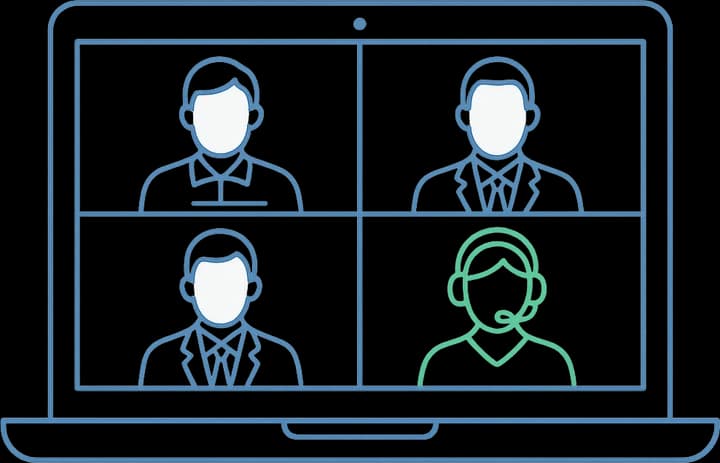
The mediator leads the session, speaks with each side in turn and does not decide the dispute. Each party joins with an attorney, who explains each offer to the client, and an insurance representative may be on the call when an insurer is paying. When a party speaks another language, an interpreter joins the same meeting as a guest and stays with that party.
On the call5
MediatorLeads the session and speaks with each side
PartyJoins from their own location
AttorneysExplain each offer to their client
Insurance repMay join when an insurer is paying
InterpreterJoins as a guest and is moved with the party
MediatorInterpreterParty
The interpreter's role
The interpreter makes what is said as clear to the party as it would be in one language. The mediator's opening, each side's account and every offer are interpreted in full, in both directions, and the party's replies are interpreted back to the others. The interpreter is neutral, keeps what they hear confidential and does not advise the party or comment on an offer.
In a private session
MediatorInterpretedPartyInterpreted
Breakout rooms
On Zoom, the host moves participants into breakout rooms. The interpreter joins as a guest, so the host can move the interpreter into the room with the party who needs one. In a private session, the mediator speaks with one side while the other waits, and the interpreter interprets the whole talk. If the parties agree on a term sheet, the interpreter can read it to the party in their language before they sign.
On-site, video or phone
Choosing between video, on-site and phone for a mediation
Video suits a mediation when the parties are in different places. On-site or phone is the better choice in the cases below.
On-site
Book an interpreter in the room when the parties meet at the mediator's office for a full day with private sessions in separate rooms.
Enter the mediation date, start time, platform and the language of the party who needs the interpreter. The price for the booked hours shows right away.
Place your order
Pay online to confirm. The booking opens in your dashboard, where you add the meeting link and notes such as the case name and the mediator's name.
Dispatcher runs and assigns an interpreter
Our dispatcher assigns a court-certified interpreter and confirms the name and credentials to you before the mediation.
Join your session
The interpreter joins the mediator's link as a guest at the booked time. Ask the host to move the interpreter into the room with the party whenever breakout rooms open.
What you receive
The interpreter's name and credentials, confirmed before the mediation.
The meeting link kept in your project, with your notes for the interpreter.
A confirmation in your dashboard and by email.
Every file and session is covered by an NDA and sent over an encrypted connection. Clinical matters are handled in line with HIPAA.
The ones we hear most often, answered by our dispatch and project-management teams.
Can't find it here?
01Does the mediator need to know an interpreter is coming?
It helps. Send the mediator the interpreter's name from our confirmation, so the mediator can plan the breakout rooms with the interpreter in mind.
02Which video platforms can the interpreter join?
Zoom, Microsoft Teams, Google Meet or the platform the mediator uses. If the mediator has not set one up, we create a link to the Texliff room, which opens in the browser with nothing to install.
03What if the other party also needs an interpreter in a different language?
One booking covers English and one other language. A second language needs its own booking, and both bookings can use the same mediation link.
04How is a mediation by video priced?
The price is per hour for the hours you book, and you see the total before you pay. Book the time the mediator has set aside, because the interpreter is reserved for the whole booking and unused time is not refunded.
05Is what the interpreter hears kept confidential?
The interpreter works under an NDA, connections are encrypted, and sessions are not recorded unless you ask.
06Which languages do you cover for mediations by video?
70 languages. Spanish, Mandarin, Vietnamese, Arabic and Russian are the easiest to schedule. Rare languages such as Burmese or Pashto need more notice.
07Are your Turkish interpreters certified?
Yes. Court-certified and medically credentialed Turkish interpreters are assigned to legal and clinical matters — Federal Court Interpreter Certification, state court rosters, CCHI / NBCMI for medical. For community, educational and corporate settings we assign professionally trained interpreters matched to the subject.
Other languages
Other languages for Mediations
The same page for each of these languages, with that language's varieties, its register and where it is booked most.
Browse selected Turkish interpreters available through the Texliff network.
3 professional profiles
Mehrnaz I.
Interpreter
Pairs
Dari into EnglishFarsi into EnglishAzerbaijani into EnglishTurkish into English
Modes
Simultaneous, Consecutive
Settings
Video-Remote, Telephone, On-site
Mehrnaz works as a Dari interpreter and Farsi interpreter for immigration hearings, medical encounters and legal proceedings. As an Azerbaijani interpreter and Turkish interpreter, she provides simultaneous interpreting at conferences, consecutive support on-site for hearings, and language assistance by video or phone. Her 12 years of experience also include reviewing assessment materials for linguistic accuracy, dialectal variation and cultural context. Mehrnaz is a qualified federal court interpreter, a CCHI Certified Medical Interpreter and a certified immigration court interpreter. She handles English to Farsi translation for medical and immigration documents. Her work also covers Turkish to English translation and Azerbaijani to English translation for legal materials and general records, while Dari to English translation supports document review and sight rendering in court and immigration matters.
Armen translates between Turkish and English for legal, medical and immigration matters, drawing on 25 years of language experience. His translation work supports clear communication across specialized materials while preserving meaning, tone and context. Earlier experience in accounting and commercial real estate provides additional familiarity with financial and business terminology. For spoken assignments, Armen works as a court-registered Turkish interpreter in legal proceedings and handles consecutive interpreting for medical visits. He also provides interpretation services by video and phone when participants need remote language support. His extensive background encompasses court, business and school-related assignments requiring careful communication between Turkish and English.
For 20 years, Alyson has interpreted English into Turkish in legal and medical settings. A Turkish interpreter and licensed court interpreter, she interprets hearings and other court proceedings on-site or by video. In hospitals and other healthcare settings, she conveys medical discussions accurately and clearly, including assignments conducted by phone. Her interpretation services also draw on substantial experience with business operations, bookkeeping, payroll, real estate leasing, and vendor accounts. This financial and commercial background informs her command of terminology used in business and legal matters. As a Turkish translator, Alyson completes English to Turkish translation for legal and medical documents, contracts, and business records. Her document translation reflects the same subject-matter knowledge developed through two decades of spoken-language assignments.