Medically credentialed Burmese interpreters on the unit's tablet or cart, with relatives joining the same link from anywhere. Get your quote in seconds, place your order, add your meeting link, and you're all set.
Enter the visit date, start time, platform, the patient's language and the kind of visit, such as a bedside visit or a family meeting. The price for the hours you book shows right away.
Zoom, Microsoft Teams, Google Meet or the Texliff room
The interpreter joins the link as a guest at the booked time, interprets for the unit and any relatives on the link, and stays for the hours you booked.
Any device, interpreters from all 50 states
The price shows before you book. Every session is covered by an NDA; clinical sessions are handled in line with HIPAA.
Indianapolis, Fort Wayne, Buffalo, Utica, Dallas and the Twin Cities host large Burmese and Burmese-Chin / Burmese-Rohingya refugee populations.
Typical Burmese bookings
USCIS asylum and refugee interviews
Hospital, maternity and OB/GYN appointments
Manufacturing and meat-packing workers' comp
School IEP meetings
U.S. speakers
130k+
Booked most in
Indianapolis, Fort Wayne, Buffalo
Varieties
Burmese is distinct from Chin, Karen, Rohingya, Kachin and other Myanmar languages. Refugee cases often require specific language (e.g. Zomi, Falam, Karenni) which we source separately.
Joining by video
Video interpreters for hospitals at the bedside, with relatives who join remotely
On video, the interpreter and some of the people in the conversation are not in the building. Where a card has a page of its own, it links to that page for video.
Bedside visits
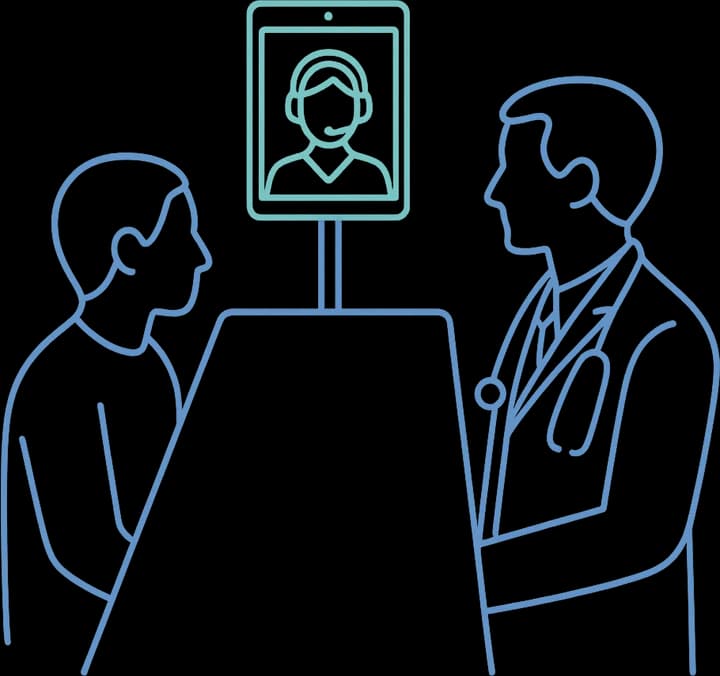
The unit joins the link on a tablet or cart, and the interpreter interprets for the doctor or nurse at the patient's bed.
What to know about video interpreters in a hospital
When video is used
Hospitals use video when no interpreter for the language works near the building, or when a relative needs to join from another city. The unit opens the meeting link on a tablet or cart at the patient's bed, and the interpreter joins as a guest from anywhere in the US. The doctors, the nurses and the patient stay together in the room, and only the interpreter is on the screen. Video is also used for telehealth follow-ups after discharge.
Who takes part
The doctor or nurse speaks with the patient in the room, and the interpreter is on the screen of the tablet or cart. A relative can open the same link from another place and listen in as family, and the unit decides who else joins. The interpreter interprets for the care team, the patient and the relative, one speaker at a time.
On the call4
Doctor or nurseIn the room with the patient
PatientSpeaks with the care team
RelativeOpens the same link from another place
InterpreterOn the screen of the tablet or cart
Care teamInterpreterPatient
The interpreter's role
On the screen, the interpreter does the same work as in the room. Every part is interpreted in full, in both directions, and a relative's question is interpreted like the patient's. The doctor or nurse waits after each part, so nothing is cut short. The interpreter is neutral, gives no advice and no summary, and keeps the visit confidential.
On the tablet
DoctorPauseInterpretedPatient answersInterpreted
Joining at the bedside
Put the meeting link in the dashboard before the visit, and open it on the unit's tablet or cart a little before the booked time. The interpreter joins as a guest, so the patient and the staff stay where they are. Each part is said twice, once in each language, so a bedside visit with many questions needs more booked time than one in English.
On-site, video or phone
Choosing between video, on-site and phone for hospital care
Video brings in an interpreter who is not near the hospital. In the cases below, a different setting works better.
On-site
Book an interpreter in person for a long family meeting or a unit with a weak connection.
Enter the date, start time, the platform, the patient's language and the kind of visit. The price for the booked hours shows right away.
Place your order
Pay online to confirm. The booking opens in your dashboard, where you add the meeting link and notes such as the unit and the doctor's name.
Dispatcher runs and assigns an interpreter
Our dispatcher assigns a medically credentialed interpreter and confirms the name and credentials to you before the visit.
Join your session
At the booked time, the interpreter opens your link as a guest. Relatives who open the same link join the conversation, and the interpreter stays for the booked hours.
What you receive
The interpreter's name and credentials, confirmed ahead of the visit.
Your meeting link kept in the project, or a Texliff room link we create if the unit has none.
A confirmation in your dashboard and by email, ready to forward to the unit.
Every file and session is covered by an NDA and sent over an encrypted connection. Clinical matters are handled in line with HIPAA.
The ones we hear most often, answered by our dispatch and project-management teams.
Can't find it here?
01Can the interpreter join our hospital's video system?
Yes, on Zoom, Microsoft Teams or Google Meet. If your system cannot add a guest, we create a Texliff room link and add it to the project.
02What if a relative speaks a different language than the patient?
Each booking is for English and one other language, with one interpreter. A relative who speaks a third language needs a second booking, and both can use the same link.
03Is the video visit recorded?
No. Sessions are not recorded unless you ask, and connections are encrypted.
04How is a video visit in the hospital priced?
A video visit is priced by the hour, and you see the total before paying. Unused time is not refunded, because the interpreter is reserved for the whole booking, so book the time the visit needs.
05Can the same interpreter join every visit during a stay?
You can ask for it in the booking notes. A booking is for the service, not for a particular interpreter, so we take the request into account and assign them when they are available.
06Which languages can a hospital book by video?
70 languages. Spanish, Mandarin, Vietnamese, Arabic, Tagalog and Haitian Creole are the easiest to schedule. Rare languages such as Pashto or Burmese need more notice, and the interpreter can join from any state.
07Are your Burmese interpreters certified?
Yes. Court-certified and medically credentialed Burmese interpreters are assigned to legal and clinical matters — Federal Court Interpreter Certification, state court rosters, CCHI / NBCMI for medical. For community, educational and corporate settings we assign professionally trained interpreters matched to the subject.
Other languages
Other languages for Hospitals
The same page for each of these languages, with that language's varieties, its register and where it is booked most.
Browse selected Burmese interpreters available through the Texliff network.
3 professional profiles
Min T.
Interpreter
Pairs
English into Burmese
Modes
Consecutive
Settings
On-site, Video-Remote, Telephone
Min is a Burmese interpreter with four years of experience providing English into Burmese interpretation. She works in consecutive interpretation across on-site, video remote, and telephone settings, specializing in medical and immigration contexts. Her background includes two years interpreting through professional agencies and two years of community-based interpretation supporting individuals with limited English proficiency. Min's professional experience also includes work in environmental services within a healthcare setting, where she followed safety and infection-control procedures and collaborated as part of a healthcare team.
Nyi is a certified Burmese interpreter with four years of experience supporting medical care and victim advocacy. Nyi provides simultaneous interpretation for medical appointments, surgeries and consultations, helping participants communicate clearly while maintaining confidentiality and professional ethics. For other conversations, Nyi uses consecutive interpreting on-site, by video and over the phone. Experience assisting victims of crime includes explaining rights and available resources, documenting case details and coordinating communication involving law enforcement and service providers. As a medical interpreter, Nyi brings active listening, attention to detail and calm problem-solving to sensitive encounters. These interpretation services are grounded in fluent Burmese and English, accurate communication and careful handling of confidential information.
Sandy interprets English into Burmese in legal, medical, and social matters, drawing on 15 years of experience. A registered court interpreter and certified medical interpreter, Sandy interprets hearings and other court proceedings, along with appointments in hospitals and clinics. Sandy is also a certified social interpreter who facilitates communication in government offices when conversations concern public programs or community needs. During on-site assignments, Sandy conveys spoken English into Burmese while preserving meaning and tone. Video sessions encompass medical consultations and legal discussions, while phone assignments connect participants who cannot meet face to face. These interpretation services reflect extensive experience across courts, healthcare settings, and government offices, with careful attention to terminology and the practical context of each exchange.