Medically credentialed Hebrew interpreters on the unit's tablet or cart, with relatives joining the same link from anywhere. Get your quote in seconds, place your order, add your meeting link, and you're all set.
Enter the visit date, start time, platform, the patient's language and the kind of visit, such as a bedside visit or a family meeting. The price for the hours you book shows right away.
Zoom, Microsoft Teams, Google Meet or the Texliff room
The interpreter joins the link as a guest at the booked time, interprets for the unit and any relatives on the link, and stays for the hours you booked.
Any device, interpreters from all 50 states
The price shows before you book. Every session is covered by an NDA; clinical sessions are handled in line with HIPAA.
New York (Monsey, Borough Park, Five Towns), Lakewood NJ, Miami, Los Angeles, Baltimore-Pikesville and Chicago have significant Israeli-American and Hebrew-speaking Orthodox communities.
Typical Hebrew bookings
USCIS naturalization interviews
Depositions in Israeli tech / IP matters
Rabbinical / beit-din coordination meetings
Hospital and behavioral-health appointments
U.S. speakers
200k+
Booked most in
New York, Los Angeles, Miami
Joining by video
Video interpreters for hospitals at the bedside, with relatives who join remotely
On video, the interpreter and some of the people in the conversation are not in the building. Where a card has a page of its own, it links to that page for video.
Bedside visits
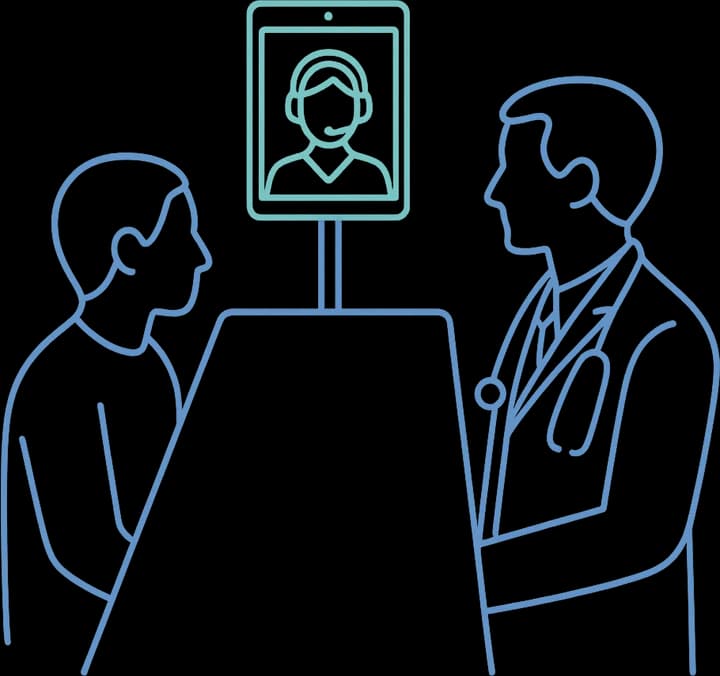
The unit joins the link on a tablet or cart, and the interpreter interprets for the doctor or nurse at the patient's bed.
What to know about video interpreters in a hospital
When video is used
Hospitals use video when no interpreter for the language works near the building, or when a relative needs to join from another city. The unit opens the meeting link on a tablet or cart at the patient's bed, and the interpreter joins as a guest from anywhere in the US. The doctors, the nurses and the patient stay together in the room, and only the interpreter is on the screen. Video is also used for telehealth follow-ups after discharge.
Who takes part
The doctor or nurse speaks with the patient in the room, and the interpreter is on the screen of the tablet or cart. A relative can open the same link from another place and listen in as family, and the unit decides who else joins. The interpreter interprets for the care team, the patient and the relative, one speaker at a time.
On the call4
Doctor or nurseIn the room with the patient
PatientSpeaks with the care team
RelativeOpens the same link from another place
InterpreterOn the screen of the tablet or cart
Care teamInterpreterPatient
The interpreter's role
On the screen, the interpreter does the same work as in the room. Every part is interpreted in full, in both directions, and a relative's question is interpreted like the patient's. The doctor or nurse waits after each part, so nothing is cut short. The interpreter is neutral, gives no advice and no summary, and keeps the visit confidential.
On the tablet
DoctorPauseInterpretedPatient answersInterpreted
Joining at the bedside
Put the meeting link in the dashboard before the visit, and open it on the unit's tablet or cart a little before the booked time. The interpreter joins as a guest, so the patient and the staff stay where they are. Each part is said twice, once in each language, so a bedside visit with many questions needs more booked time than one in English.
On-site, video or phone
Choosing between video, on-site and phone for hospital care
Video brings in an interpreter who is not near the hospital. In the cases below, a different setting works better.
On-site
Book an interpreter in person for a long family meeting or a unit with a weak connection.
Enter the date, start time, the platform, the patient's language and the kind of visit. The price for the booked hours shows right away.
Place your order
Pay online to confirm. The booking opens in your dashboard, where you add the meeting link and notes such as the unit and the doctor's name.
Dispatcher runs and assigns an interpreter
Our dispatcher assigns a medically credentialed interpreter and confirms the name and credentials to you before the visit.
Join your session
At the booked time, the interpreter opens your link as a guest. Relatives who open the same link join the conversation, and the interpreter stays for the booked hours.
What you receive
The interpreter's name and credentials, confirmed ahead of the visit.
Your meeting link kept in the project, or a Texliff room link we create if the unit has none.
A confirmation in your dashboard and by email, ready to forward to the unit.
Every file and session is covered by an NDA and sent over an encrypted connection. Clinical matters are handled in line with HIPAA.
The ones we hear most often, answered by our dispatch and project-management teams.
Can't find it here?
01Can the interpreter join our hospital's video system?
Yes, on Zoom, Microsoft Teams or Google Meet. If your system cannot add a guest, we create a Texliff room link and add it to the project.
02What if a relative speaks a different language than the patient?
Each booking is for English and one other language, with one interpreter. A relative who speaks a third language needs a second booking, and both can use the same link.
03Is the video visit recorded?
No. Sessions are not recorded unless you ask, and connections are encrypted.
04How is a video visit in the hospital priced?
A video visit is priced by the hour, and you see the total before paying. Unused time is not refunded, because the interpreter is reserved for the whole booking, so book the time the visit needs.
05Can the same interpreter join every visit during a stay?
You can ask for it in the booking notes. A booking is for the service, not for a particular interpreter, so we take the request into account and assign them when they are available.
06Which languages can a hospital book by video?
70 languages. Spanish, Mandarin, Vietnamese, Arabic, Tagalog and Haitian Creole are the easiest to schedule. Rare languages such as Pashto or Burmese need more notice, and the interpreter can join from any state.
07Are your Hebrew interpreters certified?
Yes. Court-certified and medically credentialed Hebrew interpreters are assigned to legal and clinical matters — Federal Court Interpreter Certification, state court rosters, CCHI / NBCMI for medical. For community, educational and corporate settings we assign professionally trained interpreters matched to the subject.
Other languages
Other languages for Hospitals
The same page for each of these languages, with that language's varieties, its register and where it is booked most.
Browse selected Hebrew interpreters available through the Texliff network.
3 professional profiles
Mikhail B.
Interpreter
Pairs
Hebrew into English
Modes
Consecutive, Simultaneous
Settings
On-site, Video-Remote, Telephone
Mikhail is a translator and interpreter with over 17 years of professional experience. He provides translation from Russian into English and interpretation from Hebrew into English, offering both consecutive and simultaneous modes across on-site, video remote, and telephone settings. Mikhail's specializations span legal, medical, immigration, education, business, general, financial, and marketing fields. Mikhail holds an undergraduate degree and has completed multiple professional certificates, including contract law, effective legal writing, immigration law, forensic linguistics, advanced consecutive interpreting, and machine translation post-editing. His extensive experience includes work with state and federal courts, immigration courts, and government agencies.
Ashi is a Hebrew interpreter with 25 years of experience in courts, immigration proceedings and government programs. As a court-registered interpreter, Ashi handles consecutive work on-site for hearings and depositions, while simultaneous interpreting supports complex legal and business matters. Ashi also works by video for remote proceedings and by phone for legal or government communications. Assignments have included liaison work involving counterterrorism, crisis response and explosive-incident countermeasures, supported by strong research, public speaking and cultural awareness skills. Ashi’s interpretation services also draw on experience with transcription, monitoring and sensitive subject matter. As a Hebrew translator, Ashi provides Hebrew to English translation for legal and immigration materials, contracts and business content. This document translation work includes careful terminology research and analytical review, with legal translation informed by extensive courtroom experience.
English into HebrewHebrew into EnglishFrench into Hebrew
Modes
Consecutive
Settings
Video-Remote, Telephone
Addie translates English into Hebrew and French into Hebrew, while her Hebrew to English translation and French to English translation span medical, technical and scientific content. Across 29 years, she has localized software and websites, proofread multilingual material and rendered journalistic articles for publication. As a Hebrew and French translator, she also adapts marketing presentations and commercial copy across all three languages. Her long-form work includes two English-to-Hebrew books on environmental issues, alongside book chapters and articles concerning science and technology. Addie also wrote, edited and updated a detailed technical guide in English. She writes original articles and edits complex English-language content, while her digital expertise extends to HTML coding, web design and content maintenance.