Court-certified Vietnamese interpreters for remote hearings, remote testimony, settlement conferences and mediation programs. Get your quote in seconds, place your order, add your meeting link, and you're all set.
Enter the date, start time, the court's platform, the language and the kind of proceeding. Add the court's rules for remote interpreters in the notes. The price for the hours you book shows right away.
Zoom, Microsoft Teams, Google Meet or the Texliff room
Interpretation demand is heaviest in naturalization, hospital geriatrics, and legal aid. Dialect matters — Northern (Hanoi), Central (Huế), and Southern (Saigon) Vietnamese have clear phonological and lexical differences.
Typical Vietnamese bookings
USCIS naturalization interviews
Geriatric and oncology appointments
Legal aid and family court
VA appointments for Vietnamese-American veterans
Community business licensing (nail salons, restaurants)
K-12 parent-teacher and IEP meetings
U.S. speakers
1.5M+
Booked most in
Houston, San Jose, Orange County
Varieties
Northern (Hanoi), Central (Huế), Southern (Saigon)
Remote proceedings
Video interpreters for courts at remote hearings, testimony, settlement conferences and mediation programs
Courts book a video interpreter for these remote proceedings. The first four cards link to the page for that session by video.
Remote hearings
The interpreter joins the status conferences and motion hearings that the court holds by video, for the party who speaks another language.
What to know about remote court proceedings with an interpreter
When the court allows video
A court holds a proceeding by video when it allows remote appearances, for example for a party or a witness who lives far away or cannot travel. Each court decides when remote interpreting is allowed, so tell us the court and the proceeding when you book. Video is also a way to reach a language when no interpreter for it works near the courthouse, because our interpreters join from anywhere in the US.
Who takes part
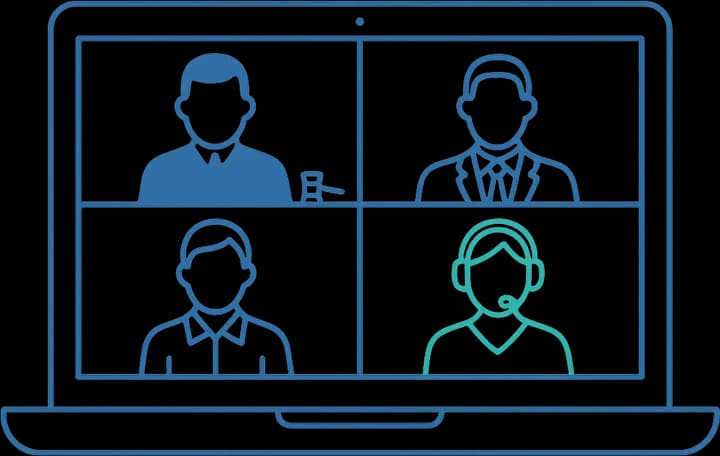
The judge presides, and the court hosts the call and admits each participant. The attorneys and parties join from their own places, and a witness may testify from another state. The interpreter joins as a guest, and the court admits them the same way, to interpret for the person who speaks another language.
On the call4
JudgePresides over the hearing
AttorneysJoin from their own places
Party or witnessAnswers through the interpreter
InterpreterJoins as a guest
CourtInterpreterWitness
The interpreter's role
The interpreter makes the proceeding as clear to the person who speaks another language as it is to everyone else on the call. Every question, every answer and everything the judge says is interpreted in full, in both directions. The interpreter is neutral, keeps what they hear confidential, and does not explain a ruling, advise a party or give an opinion.
On the call
QuestionInterpretedAnswerInterpreted
Platform and rules
Add the court's link and its rules for remote interpreters to the booking notes as soon as the court has them, along with the case name and the names of the parties. The interpreter reads the notes before the session. If the court cannot add a guest to its own platform, we create a Texliff room, which opens in the browser with nothing to install.
On-site, video or phone
Choosing between video, on-site and phone for court proceedings
Each court sets its own rules for remote interpreting, so check them before you choose video.
On-site
Book an interpreter in the courthouse for trials and for hearings where the court wants everyone in the room.
The ones we hear most often, answered by our dispatch and project-management teams.
Can't find it here?
01Which platforms can the interpreter join?
Zoom, Microsoft Teams, Google Meet and the court's own platform, always as a guest. The court chooses the platform, and the interpreter follows it.
02Can the court ask for the same interpreter at every hearing in a case?
You can ask for it in the booking notes. A booking is for the service, not for a particular interpreter, so we take the request into account and assign them when they are available.
03Do you record the session?
No, unless you ask. Any record of the proceeding is the court's.
04Can the interpreter join the video hearing from the courthouse?
An interpreter who has to travel to an office to join a video proceeding from there is an on-site booking. Book on-site for the courthouse, or book video and the interpreter joins from wherever they work.
05How is a remote booking priced?
You pay for the hours you book, and the total shows before you pay. Book the time the court has set aside, plus breaks, because unused time is not refunded.
06Which languages can we book for a remote proceeding?
70 languages. Spanish, Portuguese, French, Tagalog, Russian and Haitian Creole are among the easiest to schedule, and rare languages need more notice.
07Are your Vietnamese interpreters certified?
Yes. Court-certified and medically credentialed Vietnamese interpreters are assigned to legal and clinical matters — Federal Court Interpreter Certification, state court rosters, CCHI / NBCMI for medical. For community, educational and corporate settings we assign professionally trained interpreters matched to the subject.
08Do you cover all Vietnamese dialects?
Southern Vietnamese (Saigon) is most common in U.S. communities outside the DMV; Northern Vietnamese is used in government and formal media. We match dialect to the speaker's region of origin.
Other languages
Other languages for Courts
The same page for each of these languages, with that language's varieties, its register and where it is booked most.
Browse selected Vietnamese interpreters available through the Texliff network.
15 professional profiles
Bang T.
Interpreter
Pairs
Vietnamese into EnglishEnglish into Vietnamese
Modes
Consecutive
Settings
Telephone, Video-Remote, On-site
Bang is a Vietnamese interpreter with 10 years of experience facilitating communication between English and Vietnamese speakers. Bang provides interpretation services in consecutive mode by phone, by video, and on-site for courts, healthcare settings, and international conferences. As a legal interpreter, Bang supports depositions and immigration matters, while work as a medical interpreter includes clinical terminology and behavioral health contexts. HIPAA awareness training further supports healthcare assignments. A strong command of bioinformatics, computer science, and software helps Bang handle complex scientific and technical material with precision. As a Vietnamese translator, Bang handles Vietnamese to English translation and work from English into Vietnamese, including legal translation and medical translation. Additional capabilities include editing and proofreading scientific papers for publication. Bang uses TRADOS Studio, MemoQ, and remote meeting platforms to support accurate, efficient delivery.
English to Vietnamese translation has been Huong’s focus throughout 21 years of professional experience. A skilled Vietnamese translator, Huong handles legal translation for contracts and regulatory materials, as well as medical translation for healthcare documentation. Her work also covers technical manuals, software localization and marketing campaigns, along with immigration paperwork, educational documents and business or scientific content. She brings additional experience in transcreation, review and language quality assurance, tailoring materials to industry requirements. As a Vietnamese interpreter working from English into Vietnamese, Huong provides consecutive, on-site interpretation services for legal and medical matters. Her background supports assignments as both a legal interpreter and medical interpreter.
Thanh is a Vietnamese–English bilingual professional with twenty years of experience in translation and interpretation across financial, marketing, IT/software, education, and business sectors. Specializing in both simultaneous and consecutive modes, Thanh delivers accurate communication for on-site, video remote, and telephone assignments. Expertise includes managing fast-paced international environments, facilitating cross-cultural dialogue between executives and stakeholders, and maintaining strict confidentiality when handling sensitive information. Holding an undergraduate diploma in Communications Engineering, Thanh combines strong technical listening skills with fluent language proficiency to preserve meaning, tone, and speaker intent during complex multi-speaker conversations. Professional background includes supporting multinational corporations with bilingual correspondence, operational document translation, and real-time interpretation for high-pressure meetings. Thanh ensures seamless interaction for diverse teams through active listening, neutrality, and reliable remote-work capabilities.
Huy is a native Vietnamese speaker who provides translation and interpretation services between Vietnamese and English. Specializing in IT, software, education, legal, marketing, and general content, Huy delivers accurate and culturally appropriate results. Professional capabilities include translation, editing, proofreading, machine translation post-editing, subtitling, and transcription. Huy also offers consecutive and simultaneous interpretation for both on-site and video remote settings. With a background as an English teaching assistant, Huy possesses strong communication and language support skills developed in multilingual environments. Familiar with AI-assisted translation workflows, Huy is detail-oriented and committed to meeting deadlines while maintaining high quality standards. Holding a graduate degree in IT studied through English, Huy is eager to take on new challenges and collaborates effectively on short-term and long-term projects across diverse industries.
Ngoc is a localization and language specialist with 14 years of experience in translation, interpretation, and multilingual content operations. Working between English and Vietnamese, Ngoc provides consecutive interpretation for on-site and video remote settings across legal, medical, technical, financial, marketing, IT, education, business, scientific, and immigration domains. With an undergraduate degree in English, Ngoc excels in product localization, linguistic quality assurance, vendor management, and glossary governance. Professional background includes leading Vietnamese localization for global tech platforms, managing freelance translator pools, and overseeing terminology consistency for major digital services. Ngoc combines deep linguistic expertise with proficiency in AI-assisted workflows, CMS experimentation, and cross-functional collaboration to deliver high-quality language solutions.
Thinh is a certified court interpreter and licensed attorney with decades of professional experience. Specializing in legal, medical, technical, financial, and immigration domains, Thinh provides both translation and interpretation services, including consecutive and simultaneous modes delivered on-site, via video remote, and by telephone. Thinh holds a PhD and a JD, along with a BA in Economics. Throughout an extensive career, Thinh has worked with multiple courts, participated in administrative hearings, and transcribed numerous audio and video recordings for the District Attorney's Office, Public Defender's Office, and various conferences. Thinh translates from English into Vietnamese and interprets from Vietnamese into English, covering a broad range of specializations that also encompass marketing, IT/software, education, scientific, literary, business, and general content.
Camnhung is a certified court interpreter with over thirty years of experience providing professional interpretation and translation services between English and Vietnamese. Specializing in legal, medical, immigration, and general subject matter, Camnhung delivers consecutive and simultaneous interpretation across on-site, video remote, and telephone settings. Throughout an extensive career, Camnhung has served as a contracted interpreter for superior courts across multiple counties and has provided interpretation for public defenders' offices, insurance companies, and government agencies. Camnhung's clients have included major insurance providers, translation agencies, and language service organizations. This depth of experience across diverse legal and professional environments has established Camnhung as a trusted linguist for complex and high-stakes assignments.
John is a professional interpreter providing consecutive and simultaneous interpretation from English into Vietnamese across telephone, video remote, and on-site settings. He specializes in legal, medical, immigration, and education contexts, along with general interpretation. John holds an undergraduate degree in music education and has completed training in immigration court and court interpretation. He also holds a core certification in healthcare interpretation. With several years of professional experience, John has served as a medical, educational, and social work interpreter since 2021 and began working as a court interpreter in 2025. His language proficiency has been assessed at an advanced level in Vietnamese and at a mastery level in English.
A Vietnamese interpreter with 25 years of experience, Linh provides consecutive and simultaneous interpreting for court proceedings, conferences, and complex professional meetings. As a court-certified interpreter, Linh handles arraignments, preliminary hearings, and trials, including jury proceedings. Linh also supports international conferences and arbitration matters involving economics, science, and highly technical subjects. Assignments take place on-site or by video, with careful attention to specialized terminology and the demands of real-time communication. These interpretation services extend to seminars and high-level bilateral or multilateral meetings in government and business settings. As a Vietnamese translator, Linh handles Vietnamese to English translation of court documents, legal paperwork, and procedural materials. This document translation experience includes revising legal content for clarity and consistency.
Interpretation from English into Vietnamese is Hien’s primary discipline, with three years of experience supporting communication in healthcare, education and general office settings. As a Vietnamese interpreter, Hien works on-site in consecutive mode, conveying spoken information clearly between participants during hospital visits and school meetings. Hien’s experience as a medical interpreter includes helping patients and healthcare staff communicate about appointments, procedures and care-related information. In educational environments, Hien facilitates conversations involving school personnel and families, maintaining the meaning and tone of each speaker’s message. These interpretation services also extend to office appointments and other general interactions requiring accurate English-to-Vietnamese communication. Hien approaches each assignment as a careful message conveyor, focusing on clarity, completeness and professional communication across the settings served.
English-into-Vietnamese interpretation is Kieu Mai’s primary focus. With 24 years of experience, Kieu Mai works as a Vietnamese interpreter for medical appointments conducted by phone, using the consecutive mode to support clear communication about symptoms, treatment plans and follow-up care. Healthcare experience also includes dental, vision and hearing-related encounters. Kieu Mai is a Certified Vietnamese Medical Interpreter and has extensive experience handling sensitive terminology in remote clinical conversations. Beyond healthcare, Kieu Mai has supported calls involving banking, insurance and customer service matters. Additional responsibilities have included assessing language proficiency and interpreting skills, as well as performing quality assurance grading. This background strengthens Kieu Mai’s ability to identify accuracy issues and maintain consistency during interpretation services.
With 15 years of experience, Lan works as a Vietnamese interpreter in medical visits, school conferences and community-service appointments. Her interpretation services include consecutive delivery on-site and by phone, as well as simultaneous work for government and nonprofit meetings. She also interprets by video when remote communication is needed. Experience coordinating housing, medical care and administrative logistics gives her practical insight into complex cross-cultural situations. Lan has completed 40-hour community interpretation training and holds a Certification of Pharmacy Technician, supporting clear communication involving medications and healthcare procedures. As a Vietnamese translator, she handles English to Vietnamese translation for project materials, notes and bilingual publications. Her document translation experience also includes movie subtitles and scripts, which she adapts for cultural accuracy and readability.
English-into-Vietnamese interpretation takes An into courtrooms, law offices, medical appointments and examinations. With 15 years of experience, this Vietnamese interpreter handles consecutive and simultaneous communication during hearings, trials and depositions, working on-site or by video and phone. As a court-certified interpreter and seasoned legal interpreter, An has supported approximately 11,000 matters involving criminal, civil and family proceedings. She also covers witness testimony, attorney conferences and legal interviews while applying precise terminology, cultural awareness and confidentiality. Her medical work includes consultations, examinations and mental health matters. An also performs sight translation of legal documents, petitions and court orders when assignments require written material to be conveyed orally.
Katie is a qualified, registered healthcare interpreter with 10 years of experience as a Vietnamese interpreter. She interprets English into Vietnamese on-site, by phone, and by video during medical appointments and medication reviews. Her healthcare assignments have included C-sections, angioplasty procedures, and cataract extractions, where precise communication about treatment and patient history is essential. Extensive pharmacy experience gives Katie practical familiarity with prescriptions, dosage instructions, medication discrepancies, and insurance issues. As a Vietnamese translator, she completes Vietnamese to English translation as well as English to Vietnamese document translation. Her written work includes healthcare presentations and other non-legal documents, drawing on subject knowledge developed through years of communicating about medications and clinical care.
Thien is a Vietnamese interpreter with 10 years of experience interpreting English into Vietnamese in on-site settings. In medical appointments, Thien communicates information about symptoms, treatment plans and follow-up instructions while preserving the meaning and tone of each speaker. Immigration interpretation services include interviews and discussions involving forms, procedures and supporting records. Extensive manufacturing experience gives Thien practical familiarity with CNC machinery, blueprint reading, precision measurement and quality-control processes, strengthening communication in technical environments. Thien also interprets conversations involving equipment operation, workplace safety and production requirements. This combination of language skill and hands-on mechanical knowledge is especially useful when terminology must remain clear and precise. As a medical interpreter, Thien facilitates direct communication among participants without adding to or omitting the content being discussed.