Bosniaque Video-Remote Interpretation for audiences d'indemnisation des accidents du travail
Court-certified Bosnian interpreters for remote workers' compensation hearings, status conferences and settlement approvals. Get your quote in seconds, place your order, add your meeting link, and you're all set.
Enter the hearing date, start time, platform, the state and board, and the injured worker's language. The price for the hours you book shows right away.
Zoom, Microsoft Teams, Google Meet ou la salle Texliff
The interpreter joins the hearing link as a guest at the booked time and stays for the hours you booked.
Tout appareil, des interprètes des 50 États
Le prix s’affiche avant la réservation. Chaque séance est couverte par un accord de confidentialité ; les séances cliniques sont traitées conformément à la loi HIPAA.
Entretiens de naturalisation et d'asile de l'USCIS
Rendez-vous médicaux et de santé mentale tenant compte des traumatismes
Tribunal de la famille et succession
Orateurs américains
100 000+
Booked most in
St. Louis, Chicago, Atlanta
Varieties
Le bosniaque, le croate et le serbe sont mutuellement intelligibles mais distincts orthographiquement et lexicalement. Le bosniaque utilise l'écriture latine et accepte plus facilement les turcismes/arabismes.
Hearings we interpret
Video interpreters for workers' compensation hearings, from status conferences to settlement approvals
A workers' compensation case passes through several kinds of hearings, and the board and the judge decide which ones go remote. Our video interpreters join the three kinds below.
Status conferences
The judge reviews where the case stands and what comes next, with the attorneys and the injured worker on the call. The interpreter interprets for the worker, so the worker follows the dates and answers any question put to them.
Hearings before the judge
The injured worker may testify about the job, the injury and the treatment, with both attorneys asking questions. The interpreter stays on the call for the whole testimony, so the judge hears every answer in English.
Settlement approval hearings
When the parties have agreed on a settlement, a judge can review it at a hearing, and the injured worker may be asked about it. The interpreter interprets the judge's words and the worker's replies, so the replies are the worker's own.
Remote hearings
What to know about remote workers' compensation hearings with an interpreter
When video is used
Many workers' compensation hearings are held in person, at a hearing office of the state board. Whether a hearing goes remote is up to the board and the judge. When it does, everyone joins the same video call from their own location. Video is also a practical choice when the injured worker lives far from the hearing office, or when no interpreter for the language works nearby, because a video interpreter can join from anywhere in the US.
Who takes part
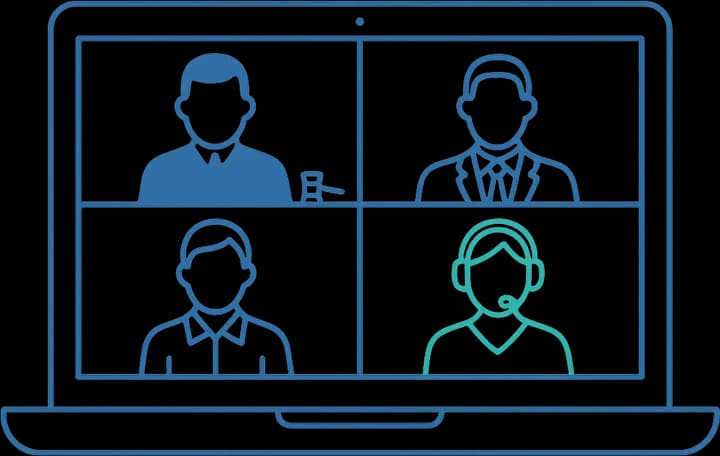
The workers' compensation judge runs the hearing and decides the issues in dispute. The injured worker testifies or answers the judge's questions. The worker's attorney and the defense attorney, who acts for the employer or the insurer, ask questions and make their arguments. A hearing reporter records what is said. When the worker speaks another language, an interpreter joins the call as well.
On the call5
JudgeRuns the hearing and decides the issues
Injured workerTestifies or answers the judge's questions
AttorneysAsk questions and make their arguments
Hearing reporterRecords what is said
InterprèteJoins when the worker speaks another language
AttorneysInterprèteWorker
The interpreter's role
The interpreter makes the hearing as clear for the injured worker as it would be in one language. Each question from the judge or an attorney is interpreted into the worker's language, and each answer into English, in full and in the first person. The interpreter is neutral and works for neither the worker's side nor the employer's side. They keep what they hear confidential and do not explain a question, give advice or comment on the testimony.
Worker's testimony
Attorney asksInterpretedWorker answersInterpreted
Link and notes
The board or the judge sets the platform for a remote hearing, so add the link to your booking in the dashboard as soon as you have it. Notes with the injured worker's job title, the injury and the names of the treating doctors help the interpreter prepare. If you do not have a link, we can create a Texliff room that opens in the browser.
Sur place, par vidéo ou par téléphone
Choosing between video, on-site and phone for a workers' compensation hearing
Video suits hearings where the judge, the attorneys and the injured worker join from different places. Another setting is better in the cases below.
Sur place
Book in person when the board holds the hearing at its office and the injured worker attends there.
How to book a video interpreter for a workers' compensation hearing
Indiquez vos besoins et obtenez votre devis instantané
In the instant quote, add the hearing date and start time, the platform, the state and board, and the injured worker's language. The price for the booked hours shows right away.
Passez commande
Pay online to confirm. The booking opens in your dashboard, where you can add the hearing link and notes such as the case number and the names of the treating doctors.
Le dispatcheur se lance et affecte un interprète
Our dispatcher assigns a court-certified interpreter and confirms the name and credentials to you before the hearing.
Rejoignez votre séance
Open the hearing link at the booked time. The interpreter joins it as a guest, and the injured worker hears the hearing in their own language.
Ce que vous recevez
The interpreter's name and court credentials, confirmed ahead of the hearing.
Your hearing link kept in the project, or a Texliff room link we create.
A confirmation in your dashboard and by email.
Chaque fichier et chaque séance sont couverts par un NDA et transmis via une connexion chiffrée. Les dossiers cliniques sont traités conformément à la HIPAA.
Questions about video interpreters for workers' compensation hearings
Celles que nous entendons le plus souvent, auxquelles répondent nos équipes de répartition et de gestion de projet.
Vous ne trouvez pas la réponse ?
01Which platforms can the interpreter join for a hearing?
Zoom, Microsoft Teams, Google Meet or the platform the board uses, as a guest. The Texliff room opens in the browser with nothing to install.
02Can the injured worker join from the attorney's office?
Yes. The interpreter joins from their own location in the US, so the worker can sit next to their attorney while the judge and the other side join from elsewhere.
03Can we ask for the same interpreter at a later hearing?
You can ask for it in the booking notes. A booking is for the service, not for a particular interpreter, so we take the request into account and assign them when they are available.
04How is a remote hearing priced?
By the hour, for the hours you book, and the total shows before you pay. Testimony takes longer when it is interpreted, and unused time is not refunded, so book enough hours for the whole hearing.
05How far ahead should we book?
At least 48 to 72 hours ahead, and earlier if you can.
06Which languages do you cover for workers' compensation hearings?
70 languages. Spanish, Mandarin, Arabic, Russian, Portuguese and French are the easiest to schedule. Rare languages such as Burmese or Pashto need more notice.
07Vos interprètes en Bosniaque sont-ils certifiés ?
Oui. Des interprètes en bosniaque certifiés par les tribunaux et accrédités médicalement sont affectés aux dossiers juridiques et cliniques — certification d'interprète des tribunaux fédéraux, listes des tribunaux d'État, CCHI / NBCMI pour le médical. Pour les contextes communautaires, éducatifs et d’entreprise, nous affectons des interprètes professionnellement formés et adaptés au sujet.
Autres langues
Autres langues for Audiences d'indemnisation des accidents du travail
The same page for each of these languages, with that language's varieties, its register and where it is booked most.
Book a court-certified video interpreter for your workers' compensation hearing.
Tell us the date, the platform, the state and board, and the injured worker's language. We confirm the interpreter's name and credentials before the hearing.
Parcourez une sélection d'interprètes en Bosniaque disponibles via le réseau Texliff.
1 profil professionnel
Jelena M.
Interprète
Paires
Serbe vers AnglaisCroate vers AnglaisBosniaque vers AnglaisAnglais vers Serbe
Modes
Consécutive, Simultanée
Modalités
Sur place, Visioconférence, Téléphone
Jelena est une interprète et traductrice agréée forte de 15 ans d'expérience professionnelle, qui travaille entre l'anglais et le serbe, le croate et le bosniaque. Elle propose l'interprétation consécutive et simultanée sur place, en visioconférence et par téléphone, ainsi que la traduction du serbe (cyrillique) vers l'anglais. Jelena est inscrite auprès du Conseil judiciaire de et a exercé comme interprète et traductrice officielle pour de nombreux tribunaux fédéraux et d'État, ainsi que pour l'Agence américaine de protection de l'environnement (EPA). Ses domaines de spécialité couvrent le juridique, le médical, le technique, la finance, le marketing, l'informatique et les logiciels, l'immigration, l'éducation, le scientifique, le littéraire et le monde des affaires. Sa vaste expérience comprend l'interprétation de séances médicales et de procédures judiciaires telles que des procès, des audiences, des dépositions et des arbitrages, ainsi que l'interprétation de conférences et d'ateliers. Elle est titulaire d'une licence en arts dramatiques et a poursuivi des études de philologie arabe et anglaise.