Uzbeque Video-Remote Interpretation for audiências judiciais
Court-certified Uzbek interpreters for status conferences, motion hearings and family court hearings held on the court's platform. Get your quote in seconds, place your order, add your meeting link, and you're all set.
Enter the hearing date, start time, platform and language, and name the court and the kind of hearing. The price for the hours you book shows right away.
Zoom, Microsoft Teams, Google Meet ou a sala Texliff
NY / Brooklyn (Rego Park, Forest Hills), Filadélfia, Chicago e Sacramento hospedam comunidades uzbeque-americanas em crescimento, incluindo falantes de uzbeque judeu bukharan.
Booked most in
New York, Los Angeles, Chicago
Remote hearings
Video interpreters for court hearings, from status conferences to family court and small claims
Parties and attorneys book a video interpreter for the hearings below. The court may appoint its own interpreter for the record, so a party's booking is for the talk with their attorney, or for a hearing where the court lets a party bring one.
Status conferences
Judges hold status conferences to check on a case and set the next dates. Send the case name and the party's name, so the interpreter has them before the judge calls the case.
Motion hearings
Attorneys argue a motion, and the judge may ask the party questions. Add the motion papers to the booking notes, so the interpreter can read the terms before the hearing.
Family court hearings
Custody and support hearings involve parents who need to follow everything the judge and the other side say. The interpreter interprets it all, so nobody has to rely on a relative or a child to explain.
Small claims
Parties in small claims often speak for themselves, without an attorney. Tell us the court when you book, because it decides whether to appoint an interpreter or let a party bring one.
Video court hearings
What to know about court hearings with a video interpreter
When video is used
Many courts hold status conferences, motion hearings and some family and small claims hearings by video, and the judge or the court's rules decide which ones. Everyone joins the court's link from their own location, and your client can join from home or from your office as the court allows. When no interpreter for the language works near the courthouse, video lets us assign one from anywhere in the US.
Who takes part
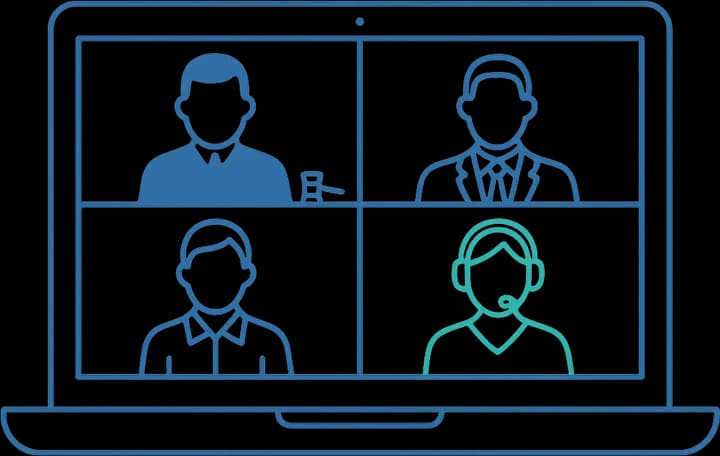
The judge runs the hearing and makes the rulings. The clerk calls the case and keeps the court's record. Attorneys speak for their clients, and the party, or a witness the judge calls, answers the judge's questions. When one of them speaks another language, an interpreter joins the call as a guest.
On the call5
JudgeRuns the hearing and makes rulings
ClerkCalls the case on the link
AttorneysSpeak for their clients
Party or witnessAnswers the judge's questions
IntérpreteJoins the call as a guest
JudgeIntérpreteParty
The interpreter's role
For your client, the interpreter makes the hearing as clear as it is for everyone who speaks English. Statements by the judge and the attorneys are interpreted in full, and your client's answers are interpreted into English for the record, in the first person. The interpreter stays neutral, gives no advice and keeps everything confidential.
With an interpreter
JudgeInterpretedPartyInterpreted
The court's link
Remote hearings run on the platform the court names, and the court sends the link. Add it to your booking in the dashboard as soon as you have it, together with the case name and the names of the people who will speak. A Texliff room link works for your own calls with your client, but the hearing itself runs on the court's platform.
Presencial, por vídeo ou por telefone
Choosing between video, on-site and phone for a court hearing
Video is the choice when the court holds the hearing on a link. The other settings fit the cases below.
No local
Book an interpreter at the courthouse when your client will be in the courtroom for the hearing.
Questions about video interpreters for court hearings
Aquelas que ouvimos com mais frequência, respondidas pelas nossas equipas de expedição e gestão de projetos.
Não encontrou o que procura?
01Can the interpreter also join my call with the client before the hearing?
Yes. Book the call as its own session, on your own link or a Texliff room link. Ask for the same interpreter, and we assign them when they are available.
02Does the interpreter need to be court-certified?
Most state courts require a certified or registered court interpreter for proceedings on the record. We assign a court-certified interpreter, and you see the name and credentials before the hearing.
03Can you interpret a hearing in a court in another state?
Yes. Our video interpreters join from anywhere in the US, so the court's location does not limit who we can assign.
04What if the court moves or cancels the hearing?
Cancellation is in writing. You get a full refund more than seven days before the hearing, 75% between seven days and 48 hours before, and no refund once it is 48 hours or less before.
05How is a video court hearing priced?
It is priced by the hour for the hours you book, and you see the total before you pay. Unused time is not refunded, so book the time the court has set aside, plus some extra for a talk with your client.
06Which languages can you interpret in court hearings by video?
70 languages. Spanish, Mandarin, Vietnamese, Arabic and Haitian Creole are the easiest to schedule, and rare languages such as Burmese or Pashto need more notice.
07Seus intérpretes de Uzbeque são certificados?
Sim. Intérpretes de uzbeque certificados por tribunais e credenciados na área médica são designados para assuntos jurídicos e clínicos — Certificação de Intérprete de Tribunal Federal, listas de tribunais estaduais, CCHI / NBCMI para área médica. Para ambientes comunitários, educacionais e corporativos, designamos intérpretes profissionalmente treinados e adequados ao assunto.
Outros idiomas
Outros idiomas for Audiências judiciais
The same page for each of these languages, with that language's varieties, its register and where it is booked most.
Conheça intérpretes de Uzbeque selecionados, disponíveis pela rede Texliff.
2 perfis profissionais
Abdul S.
Intérprete
Pares
Pachto para InglêsDari para InglêsFarsi para InglêsUzbeque para Inglês
Modos
Consecutiva, Simultânea
Modalidades
No local, Vídeo remoto, Telefone
Abdul é intérprete médico e linguista experiente, especializado em dari, pachto, persa (farsi) e uzbeque, com mais de 15 anos de experiência profissional em contextos médicos, governamentais, militares, de refugiados e comunitários. Seu foco principal é a interpretação médica, em que oferece comunicação precisa, confidencial e culturalmente sensível entre pacientes, familiares e profissionais de saúde. Abdul tem ampla experiência em interpretação em pediatria, saúde mental, atendimento à maternidade, cirurgia, pronto atendimento e clínica médica, prestando serviços de forma presencial, por telefone e por interpretação por vídeo remoto. Sua trajetória também inclui o apoio a refugiados afegãos, operações governamentais e militares e organizações humanitárias. Abdul é bacharel em Administração e Planejamento e intérprete médico certificado, com formação em terminologia médica, conformidade com a HIPAA, ética do intérprete, atendimento com base em trauma, competência cultural, interpretação simultânea e prevenção de infecções. Ele aborda cada atendimento com precisão, profissionalismo, imparcialidade, confidencialidade e respeito pelas pessoas que atende.
Intérprete de uzbeque com 25 anos de experiência, Otabek trabalha do inglês para o uzbeque e do uzbeque para o inglês. Como intérprete jurídico, ele presta apoio simultâneo e consecutivo em audiências, sessões de mediação e reuniões em escritórios de advocacia. Sua experiência como intérprete médico inclui a comunicação entre pacientes e profissionais de saúde em hospitais, cuidados paliativos e pronto-socorros. Otabek também atua em assuntos de imigração, usando serviços de interpretação por vídeo ou telefone em entrevistas e consultas. Em trabalhos presenciais, ele adapta sua abordagem ao local, aos participantes e à complexidade da conversa. Sua experiência inclui consultoria linguística para juízes, mediadores e conselheiros, além de apoio de ligação a pacientes internacionais. Ele também traduz documentos jurídicos e médicos, apoiando-se em amplo conhecimento dessas áreas, desenvolvido em seu trabalho com a língua falada.